
VIII Plenum. Dodatek nadzwyczajny PKF 1956
The hot events of October 1956 were considered so important, as to be edevoted an individual, though very short (3 minutes long), newsreel edition.
The hot events of October 1956 were considered so important, as to be edevoted an individual, though very short (3 minutes long), newsreel edition.
A documentary with traces of a feature film, about an altruistic doctor from Gorice village. Despite having a modern health centre at his disposal, he struggles with people's distrust and backwardness. "I knew that they are hiding the sick in their cottages just now. Hiding them from me, from a doctor taking sick children to hospital by force and with the help of the Citizen's Militia officers".
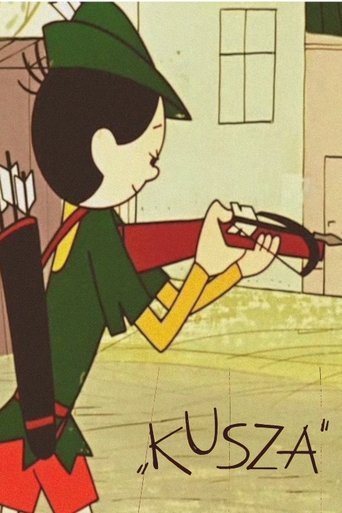
Bolek and Lolek repeat the legendary shot to an apple. Bolek places an apple on Lolek's head and shoots a crossbow.

There's no April 31 and May the 1st is a Labour Day - the most important communist holiday. A gritty morning in the city of Lodz seen through the eyes of a worker who spends it with his colleagues drinking and talking about shady businesses. He's proud of his proletarian roots, but the reality is rather bitter than sweet for him. However, he seems to be happy living in his simple world of dreams, TV programs and drinking cheap wine. The viewer is left with a dissonance between the backyard and the facade, bwetween "normal" existence and the ideology and content of TV programs.

Experimental animation short from Poland.

Animation short by Wojciech Bakowski
The Nurse of the Poznan Hospital takes care of the newborn babies. From time to time she meets very lonely newborns that are taken away from their parents or are unwanted. All these situations are very sad. The Nurse takes care of these lonely newborns, even staying after work to make their first day better by giving them a heart therapy.
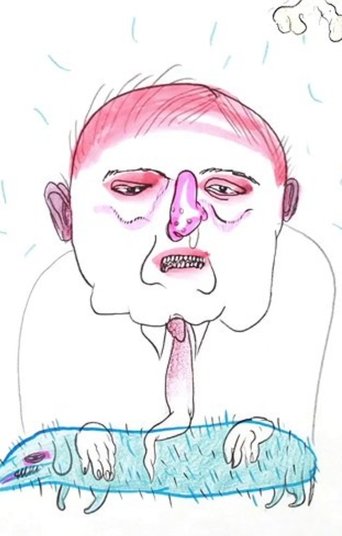
The reality presented in the film Oh God might be described using such terms as inertia or chaos. The characters feature lack of willingness to take any action, they are passive and indifferent, unable to create their own reality. The author presents a world that loses its original shapes and loses its identity. Groaning “oh God” as a main theme combines it all: grimace, sigh and a quiet whisper of despair over our own impotence.
“Can a fascist say "I love you" in another language?” asks Johannes Gierlinger the director of Remapping the Origins. The polish city of Bialystok is the birthplace of Ludwik Lejzer Zamenhof a Polish medical doctor, inventor, and writer mostly known for creating Esperanto in 1873 while still in school, a constructed language that he believed could be a universal tool to help bridge the gap between different languages. But Bialystok is also the birthplace of David Abelevich Kaufman, known worldwide as Dziga Vertov, one of the most important cinema theorist ever, Soviet pioneer, revolutionary filmmaker, documentary, and newsreel director. The city is also the place where anarchistic communes were organized during the Russian Revolution and where the Nazis build a ghetto for Jews.
The camera pulls us into diaristic and languid images of the area around Rotterdam. We can hear the artist’s hypnotic voice in two languages, which some can understand, while for others it tends to provide no more than an abstract tone, a rhythm. Her sensuous narrative of the imaginary world gradually leads us into Europe’s largest port. The narrator steers us through a sequence of sleepy images. The omnipresent water surrounds us, we experience it with virtually all our senses. Her camera shifts between immersing itself in it and floating on its surface, between close-ups and aerial shots. The story told by Cold Body Shining is first and foremost about light. The sea shimmers with the bioluminescence of dead fish. After they die, herring emit light from the fatty phosphorous substance on their skin’s surface. This light lasts four or five days before they begin to decay.

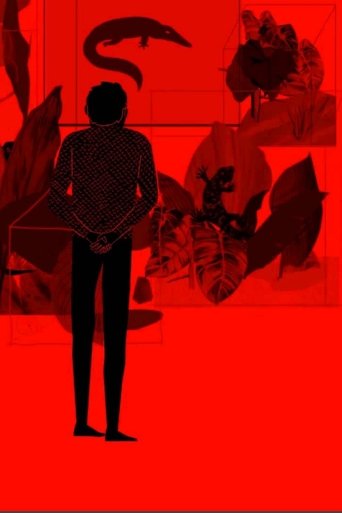


One day, She notices, that something strange is going on with Him... "Beside oneself" it’s a short animation film about confrontation between ideas of things and a real world. Do we live with real people, or only with our imagination of them
