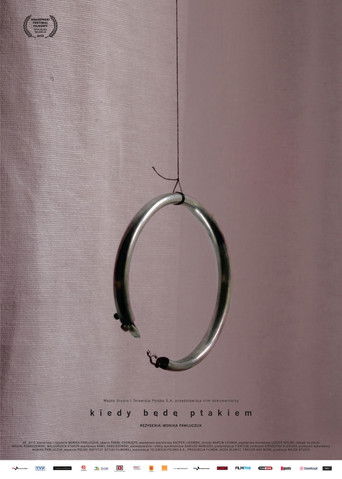
When I Am a Bird

When I Am a Bird 2013

1

She would like to return as a little bird in the next life, small enough to hide. Right now she still lives in a bird cage, at the mercy of the whims of a fate that transported her and her family from Myanmar to a refugee village in the Thai jungle. The rain drums ceaselessly on the roof. The torrential river in front of the house is as powerful as the suppressed feelings of a woman who gave birth to 12 children and lost some of them. She hasn’t chosen her husband; moreover, he sometimes flies away. Now she only hopes that her daughter will follow.

2013

The Last Mowers

The Last Mowers 2013

1

Working the boggy meadows at the river Biebrza are the titular last mowers, passing on the tradition of mowing the grass by hand to a sparse handful of successors. Here, long contemplative shots of unique wildlife make the human order merge with the order of nature.

2013

The Rules of the Game

The Rules of the Game 2013

1

The film closely follows the lives of patients in a hospice. We witness their everyday existence – their tears, pain and suffering, but also some joyful moments. For, against all expectations, a hospice is not only a place where one comes to die.

2013

Obrazy z fabryki śmierci

Obrazy z fabryki śmierci 2011

1

A story about paintings and drawings created in the Auschwitz concentration camp. The film is a search for an answer to why so many people were risking their lives just to leave on paper a trace of what the morning appeal looked like.

2011

Out of Reach

Out of Reach 2010

1

Karolina and Klaudia are trying to rebuild their own family relations, something that adults have failed to do for years. However, achieving this turns out to be much more difficult than they could have imagined.

2010

Grotowski - Flaszen

Grotowski - Flaszen 2010

1

Ludwik Flaszen, co-founder of the Laboratory Theatre, comes to Wrocław. He follows in the footsteps of Jerzy Grotowski and talks about his friendship and cooperation with this outstanding reformer of 20th century theatre. Ludwik Flaszen's stories are accompanied in the film by excerpts from recordings of performances, TV programmes and documentaries or hitherto unpublished archival photos, as well as by an extensively illustrated historical context.

2010

Explosion of Silence

Explosion of Silence 2007

1

The film tells the story of deaf soldiers fighting in the Warsaw Uprising. Few people know that a platoon of deaf soldiers fought in the Uprising and suffered no casualties. It is a unique documentary, just as unique as the everyday situation of its protagonists and the special event in which they participated. The film lifts the veil of mystery that surrounds, for most of us, functioning in a world of absolute silence, where not even the slightest murmur can be heard.

2007

The Pyramid Kids

The Pyramid Kids 2007

1

he political transformation in the areas which used to be state-owned farms in the north of the country brought unemployment and a lack of prospects. The plight of these areas has caused their residents to lose control of their lives and become marooned. They look indifferently at the crowds of tourists who come to visit the mementos of the pre-war Prussian magnates of these lands. The most popular is the pyramid-shaped tomb built by the Farenheit family. An opportunity missed by parents was noticed by children. Wanting to improve the lot of their families, they decided to take advantage of the historical legacy and began hiring themselves out as tourist guides. Thanks to this work, they not only support family budgets and gain funds for their own pleasures, but also learn history and foreign languages.

2007

The Celebration of Erwin Koloczek

The Celebration of Erwin Koloczek 2007

1

A memorizing documentary, is inspired by the documentary films - the specific genera that is commonly used to mythologize the heroes of mass culture in order to emphesize their celebrity status.

2007

Olter

Olter 2006

1

A tribute to a Polish jazz drummer, Jacek Olter (1971-2001). Olter played in many bands connected to so called 'yass' scene and was considered one of the best young talents in the genre. Though presently not as blossoming as in previous decade, Yass (a term coined in the 1980s) was a musical amalgam of various styles, with strong jazz/improv roots and influenced by punk rock, folk, electronica.

2006

Repetition

Repetition 2005

1

A documentary about the re-enactment of the Stanford Prison Experiment - a famous psychological experiment studying human behaviour in prison conditions, conducted in 1971 by Professor Philip Zimbardo at Stanford University in California. In early 2005 the artistic radical Artur Zmijewski took the risk of reconstructing Professor Zimbardo's experiment in Warsaw. He tried to recreate precisely the architecture of the simulated prison and its rules. Seven "prisoners" and nine "guards" were selected in a procedure aimed at eliminating mentally unstable candidates. They were offered $40 a day for their role in the experiment. The rooms were equipped with one-way mirrors, and the course of the experiment was filmed by five man-operated cameras and several night vision-enabled industrial TV cameras. In the process, Zmijewski pierces through societal masks and travels to the heart of mankind, where it is still dark.

2005

Here In The Street

Here In The Street 2004

1

The extended television version of the film 83 Zlota Street, offering an expanded look at the various colourful characters introduced there.

2004

Sculpture Plein-air. Swiecie 2009

Sculpture Plein-air. Swiecie 2009 2009

1

Artur Zmijewski, a Polish artist born in 1966, explores social norms through films and photographs by creating unusual situations and documenting participants’ reactions. His work often addresses long-term trauma from historical and sociopolitical events, focusing on marginalized groups and popular beliefs. In “Sculpture Plein-air. Swiecie 2009,” Zmijewski organized workshops where Polish artists collaborated with steel workers in Swiecie to create public sculptures, inspired by 1960s collaborations in Elblag. This project questions the possibility of overcoming current social and political divides.

2009

The Fourth Man

The Fourth Man 2010

1

Wilderness in the Bieszczady mountains, with the nearest shop eight kilometers away. These are the conditions in which Zbyszek who burns charcoal decided to live. He treats hard work as a kind of atonement for his past deeds. Three tar makers who worked with him, including his son, are already dead. The man sees a link between their deaths and his deeds. His next companion is black Gustaw whose dream is to study medicine. Will he turn out to be the title fourth man?

2010

Feminine - Masculine Issues

Feminine - Masculine Issues 2001

1

Borzecka made a film about love. In this type of feature film, the characters are usually young, beautiful, and rich, or at least hold two of these characteristics. The heroes of this film are the complete opposite. They are neither young, rich, nor beautiful. At times, however, they become beautiful. With the love that brightens their faces, reduces wrinkles, eradicates years and ailments. It brings joy. It calms anger and despair. Borzecka found her characters in the senior clubs— places where older people, often alone, try to get out of the circle of isolation, have fun, and especially to love and be loved.

2001

Stadion, czyli Jarmark Europa

Stadion, czyli Jarmark Europa 1998

1

An analysis of the space of the Stadium of the Decade. Formerly the site of the most important sporting events and state celebrations, since 1989 it has become one of the largest markets. The director, presenting one day in the life of the Fair Europe, shows his multi-level construction and the hierarchy of sellers, often coinciding with the topographic layout of the stadium and national affiliation - mainly Polish or Vietnamese, though there are also other visitors from outside the eastern border. The film creates a mosaic of stories told by traffickers, policemen and local criminals. Their accounts show the realities of stadium life - the day of work begins at night, and besides trade, it is filled with numerous thefts, frauds and ethnic tensions. The film also uses archival material from the Documentary and Feature Film Studios, showing the life of the stadium in PRL.

1998

Gardzienice: Expedition to the Ukraine

Gardzienice: Expedition to the Ukraine 1992

1

The Association of Theatrical Practices Gardzienice was founded in 1976 by Wlodzimierz Staniewski in a village near Lublin, which remains the group's headquarters to this day. Staniewski had just finished a five-year period of collaboration with Jerzy Grotowski’s Teatr Laboratorium. The group does create theatrical productions, but its main work is to conduct research into folk culture, as well as ethnic and anthropological studies. Members of the group take part in expeditions. There the shape of future productions is formed, productions which are evolving more and more closely towards modern mystery plays, restoring tragedy from the spirit of music. In this documentary, the process of the very particular "ethno-theatrical" expeditions that Gardzienice Centre was making in the past is portrayed. It shows the preparation, the way that the interactions with local communities happened, and how the material that was collected later informed them during the creation of performances.

1992

Women, Cats and Children

Women, Cats and Children 1995

1

A short documentary about women, cats and children and the relative importance of each to the other.

1995

Where To

Where To 1990

1

The leitmotif of this editing film is the images of the first May marches, which were noisy every year during the communist era. The streets of Warsaw are walked by properly formed and organized masses of people, and from the grandstand they are greeted by successive leaders. There is an atmosphere of more or less artificially inspired enthusiasm. As time goes by, however, more and more images appear, contrasting with this idyllic vision of a constant holiday. Alongside images of official ceremonies, materials showing competitive, independent celebrations, organized by the illegal opposition, and pacified with the help of properly trained ZOMO troops, find their permanent place.

1990