
Antos in Warsaw For the First Time 1908
Lost Polish comedy short from 1908. Not to be confused with the 1916 remake of which a small portion survives.
Lost Polish comedy short from 1908. Not to be confused with the 1916 remake of which a small portion survives.

Short reportage
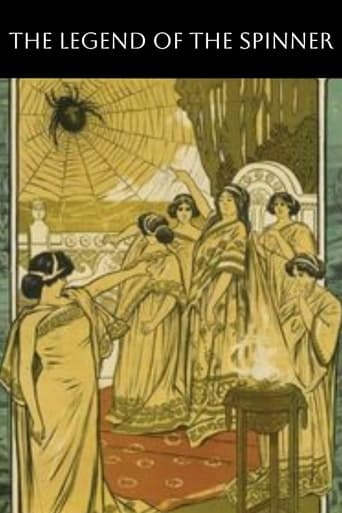
The goddess Minerva is jealous of the young Arachne who is more clever it in weaving. Out of spite, Arachne Minerva rushed into hell, then transforms into a spider that will forever spinning its web.
M. Rasta, a high society con man, is accused of a crime he didn't commit.
FRAGMENT | A man lies on his deathbed and shows his will to his carer. After his death, a grieving man and woman come in. The scene changes and we find ourselves on a beach in the company of two couples. They’re about up to fight on a cliff, and one of the men plummets to his death. Then the scene changes again to a living room with a sobbing woman. (Stumfilm.dk)
Among the many famous 16th-century samurai who made the leap from myth and ukiyo-e to early cinema screen was sword-master Miyamoto Musashi, previously depicted in prints by Kiniyoshi Yoshitoshi and others slaying an array of grotesque creatures including giant bats, giant lizards, and the mythical tengu. This imagery informed his first screen depiction in Miyamoto Musashi Taiji No Ba, which showed him combatting the mythic white ape of the mountains.
Farmer Pumpkin's pig won the blue ribbon at an exhibition and visits the photographer's to have his prize pig photographed. The farmer, the photographer give chase to Rastus, who has stolen the pig with the intention of eating it.
When his wife dies, knight Svend Dyring gets married to noble Mrs. Guldborg. Little does the good knight know that Mrs. Guldborg is in fact pure evil, and that she and her daughter Ragnhild torment the knight’s children when he’s not home. One day, when Svend Dyring is injured in a hunting accident, the eldest daughter Regitze takes upon herself to take care of her father. Mrs. Guldborg looks on in envy, while the relationship between the father and his daughter is strengthened. She’s secretly planning how to get the daughter off the scene. (stumfilm.dk)
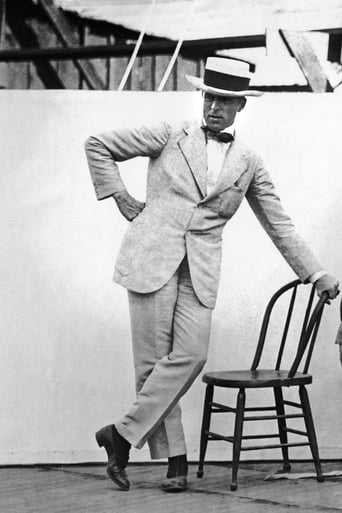
The hero, who fancies himself a ladies' man, cannot resist winking at every comely lass who passes his way. Unfortunately, he winks once too often, and soon the would-be Romeo is running for his life, pursued by an angry boyfriend. Disaster does indeed plague our hero for the rest of the picture.
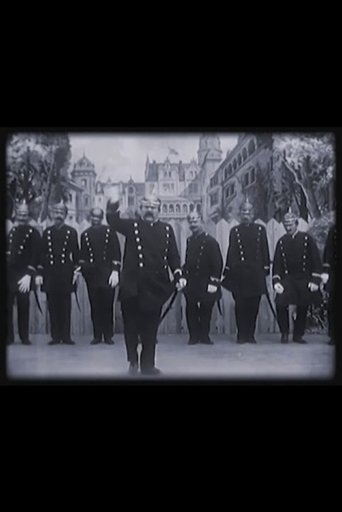
Policemen singing a song.
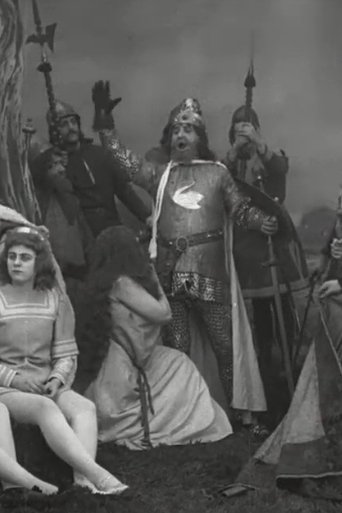
Tonbild (Sound Picture) for the duet "Wenn ich im Kampf für dich siege" from the first act of Richard Wagner's opera "Lohengrin".
Some jubilant young men have decided to end their evening of pleasure by taking supper in a restaurant after having passed a few hours at a masquerade ball. When they have regaled themselves they order a Hungarian orchestra to come and play for them so that they may continue the joys of the dance. Unfortunately, one of the men conceives the idea of speaking to the serving woman at the counter. In his excitement, he seizes the counter and shoves it over, sending to the floor everything on it, including the glasses, plates, cups and saucers. They all fall and break with a terrific noise. The police, summoned by the proprietor, arrest the ringleaders and carry them off to the police station. During the hearing of their complaints, the two prisoners escape, one by the window, the other through the door. The police dart into the street during a snowstorm in pursuit.

"The angel in this film is a little girl who is struggling hard to keep alive her old mother, who is lying ill on a pile of rags. She tries in various piteous ways to scrape together-enough to keep her parent alive, and one scene shows her on the steps of the church, where are also gathered a number of beggars of various descriptions. As the people leave the church they pass through and give their mite as they will; in this way the girl receives a few coins and with this she purchases some refreshment for her mother. With skipping, joyful steps the little angel goes back to the hovel and bends over the form. But as she reaches down her mother suddenly falls back, and in another moment is dead. The child, dazed and taken completely by terrible surprise, quakes for a few seconds with emotion then loses her reason..." Moving Picture World, March 1908
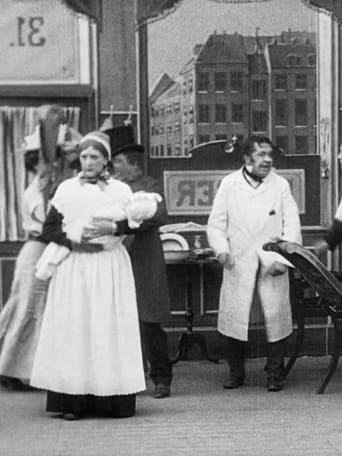
It’s the day of the barber’s baby’s christening, and the guests start arriving with their flowers and gifts, dropping them off while the barber is still trying to see to his last customer. As it’s taking a while, the wet-nurse is asked to take the baby on a short walk before the ceremony begins. She comes across a handsome young soldier, who she strikes up a conversation with. When an even more handsome man passes by, she hands the baby to the soldier. He has to return to the barracks, so he finds someone to leave the baby with. As time passes, the party start to wonder where the baby is. Fortunately, the baby has been handed in at the police station, where the parents reunite with their child. (stumfilm.dk)
A man is rude to everyone he meets and is thrown into the river.
Released the same week than Selig's version, they both were the first film versions of the popular play, adapted from Ellen Wood's 1861 novel.
The distressing plight of a young man who, dissatisfied with the food his wife serves him, eats horse meat, develops various equine mannerisms, and eventually lands in the hospital.
A Spanish dancer, in front of an inn in the Spanish mountains, is courted by a smuggler, who asks her to marry him. She agrees. Later, in the dancer's room, another man enters and declares his love for her. The smuggler, entering unnoticed, hears the declaration of love, and a violent argument breaks out between the two rivals for the dancer's affection. The suitors travel to a remote spot in the mountains and fight to the death; the smuggler wins the fight when the other suitor falls over a precipice. Returning to the dancer's room, the smuggler comes to meet his beloved, but the dancer refuses him when she finds out he killed his rival. The smuggler stabs himself in despair. The dancer, running to his corpse, touches his hands, and is repulsed to find them covered with blood.

An old farmer named Nhô Anastácio arrives in the capital for the first time. While visiting Rio de Janeiro's tourist attractions, he meets a singer and flirts with her until his wife arrives from the countryside. (Synopsis based on the book "Este Mundo É um Pandeiro . a Chanchada de Getulio a Jk" by Sergio Augusto)

A posse forms to track down a band of cattle rustlers after a rancher offers $500 reward for their capture.

