Our Art Class Makes a Film

Our Art Class Makes a Film 1971

1

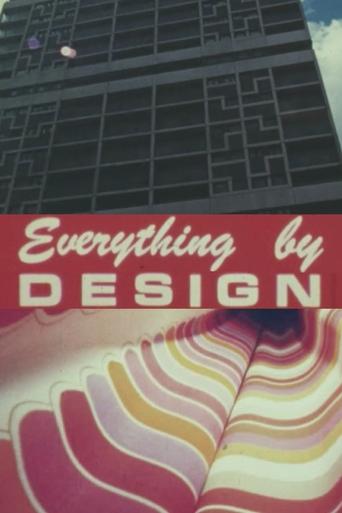
The film you are about to see is the outcome of a two-semester high school art project. It was made by a seventh grade art class at Charles Evans Hughes Junior High School in Woodland Hills, California. After seeing it, we felt it should be shared with other classes and other teachers.
1971

The Events at Garabandal

The Events at Garabandal 1971

1

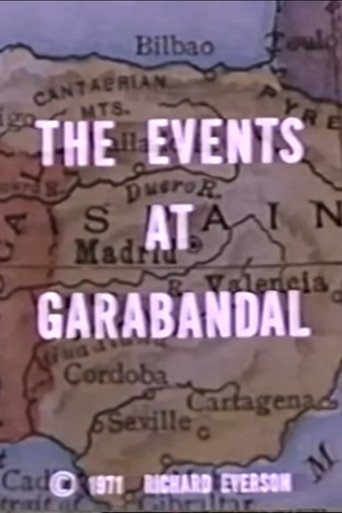
This documentary by Richard Everson marked the first groundbreaking attempt to depict the events of Garabandal in color 16MM film.

1971

Quiet Snow

Quiet Snow 1971

1

"People with an abiding interest in what young America is thinking today will be happy to learn that with perhaps one exception all the movies in the Whitney Museum's current Teen‐Age Filmmakers program are concerned with nightmare visions. The one exception is “Quiet Snow,” a nature study by Rob Hahn and Corey Kaup, which earns its “perhaps” because after several minutes of pastoral imagery it ends with about 30 seconds of mere blackness accompanied only by noise. For all I know, that may be a nightmare." - Roger Greenspun, New York Times, Oct. 19th, 1971

1971

Our Realms as We Lived Them

Our Realms as We Lived Them 1971

1

"An elaborately structured and miserably acted unveiling of how ruinous people are, it looks like nothing so much as a rich kids' meditation on the vanity of life—from the point of view of a posh Manhattan townhouse." - Roger Greenspun, New York Times review Oct. 19th, 1971 David Wise, the son of Electronic Arts Intermix founder Howard Wise and producer Barbara Wise, was a child prodigy whose pre-adolescent films led him to be described by Jonas Mekas as "the Mozart of Cinema." The young Wise would be trained in stop frame animation by Stan Van der Beek, before going on to his later career as a successful writer of science fiction film and television.

1971

Spirits Underground

Spirits Underground 1971

1

A drunken subway rider is haunted by a toy train, a horde of little people, and the spectre of his drunken grandeur. The news dealer passes through several gross transformations—and some marvelous hallucinations—to emerge as a redsuited monster, a Dr. Jekyllless Mr. Hyde.

1971

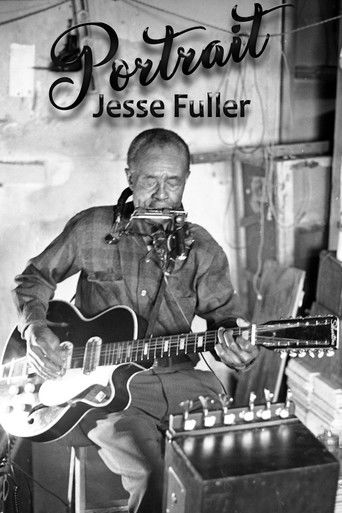
Portrait - Jesse Fuller

Portrait - Jesse Fuller 1971

1

A KRON-TV film documentary featuring the last public concert given by one man band musician Jesse Fuller, in Oakland Museum's Cowell Hall on May 7th 1971. Fuller is seen playing several songs (including 'San Francisco Bay Blues') and bantering with the audience, recalling how he appeared in Raoul Walsh's 1924 movie 'The Thief of Bagdad'. Also includes close-up views of him playing his guitar and fotdella (a foot operated percussion bass) and talking about his playing style. Begins and ends with brief scenes of Fuller walking around his Oakland neighborhood.

1971

Understanding Composition in Art

Understanding Composition in Art 1971

1

This short documentary explains the importance of formalist elements such as positive/negative space, texture, color balance, and rhythm in painting and sculpture. The film characterizes these various compositional strategies as being universal, but foremost stresses their manifestation in twentieth-century art.

1971

Wieviel Erde braucht der Mensch?

Wieviel Erde braucht der Mensch? 1971

1

"Take a circle as big as you want, just come back to the place you started from before sunset. All the land you go around is yours."

1971

Serigne Assane

Serigne Assane 1971

1

Popular comedy on traditional society and pamphlet against maraboutism. Two stories follow each other: a young typist is raped by a marabout who will not be worried, while a young man, opposed to the laxity of the brotherhoods of the administration, resists multiple solicitudes.

1971

Still Life

Still Life 1971

1

"A voyage into red cabbage and shells. Shells transform themselves into orange canyons. Cabbage as the universe! A painter's film. Soundtrack: the sound of the sculptures of the Baschet brothers." - RS

1971

Needle at Sea Bottom

Needle at Sea Bottom 1971

1

Influenced by the early theories of Sergei Eisenstein (1898–1948), in Needle at Sea Bottom I sought to create and implied time and space not found in either of the component images…the power of still awareness is literally depicted…. The film’s title is taken from the name of a specific named movement in the Tai Chi Chuan.

1971