
Populär Vun Poland

Broken Tale 2016
Udomowienie 2015
Behind the Poster 2010
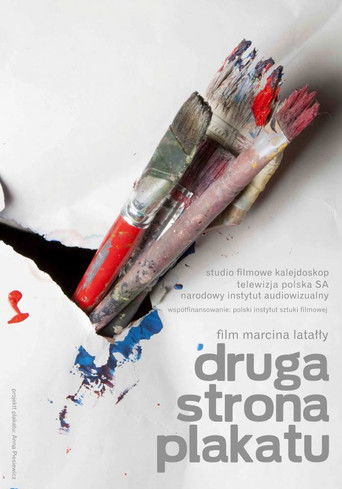
The "Polish Poster School" is as widely known around the world as the Polish Film School. Beginning with the post-World War II era, the poster became a key tool for popular communication. In Communist times, the poster also offered colorful accents to an otherwise overwhelmingly gray public space. Ironically, during the 1950s, '60s and '70s (when several Polish graphic designers rose to worldwide prominence), the advertising of films was not a necessity. A frustrated and hopeless populace regularly relied on cinema for escape. It was in that time of massive unrest that artists like Julian Pałka, Jan Lenica, Roman Cieślewicz and Henryk Tomaszewski created the most expressive and unique images of the form. Marcin Latałło's lauded documentary film is a double-layered construction, telling both the story of the movement and, in parallel, following the footsteps of Ania, a young designer who faces an extremely tricky challenge: she must create a poster for the film itself.
Impreza 2017
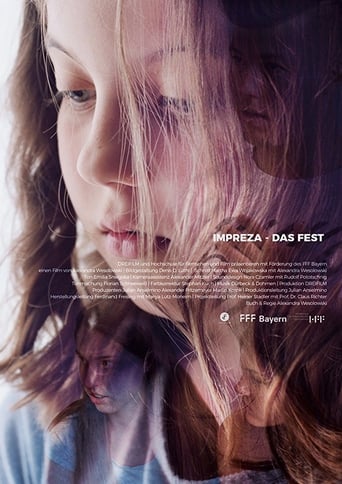
The whole family is helping with preparations for Danuta and Maciej’s golden wedding anniversary party. Danuta knows exactly what she wants and delegates her wishes to those around her. Her German niece Alexandra, the maker of this film, has travelled to Warsaw to take part. Barely has she sat down at the kitchen table when a heated discussion ensues. Be it abortion or migration, it soon dawns on Alexandra that her view of the world could not be more different from that of her right-wing conservative relatives in Poland. Alone in her ‘liberal’ view Alexandra is mocked as a victim of western propaganda… Filmmaker Alexandra Wesolowski uses a family gathering as an opportunity to portray her own family and allows us intimate insight into Polish society and the populist national-conservative Europe of today.

Mezo lithos 1970
In February 1971 1971
Peasants clash with the Party bureaucracy during a village meeting.
The 24 Hours of Jadwiga L. 1967
A look at the life of a woman in communist Poland whose day is divided between monotonous factory work, standing in queues for food, and taking care of her children.
Flesh Area 2009
Gory zombie survival from Poland
Skalpel - Made in Polska 2015
For years, they functioned on the Polish music market as "those who appear in the label Ninja Tune." Today Wroclaw duo refers to the tags of humor. "Oh look! Good Polish and appreciated abroad "- he laughs Igor Box and adds:" Our success has had a national character. We drew on the tradition of Polish jazz, and drew from it [...] our Polish vanity was met by [our] team. " During the concert, we will hear the following songs: 1. Intro 2. Test Drive 3. Konfusion 4. Break in 5. If Music Was that Easy 6. Simple Version 7. Sigma 8. Sea 9. Flying Officer 10. Sculpture 11. So Far 12. High 13. Not to Bad 14. Break out
60 lat - urodziny wujka Jorga 2009
An amateur recording of George Polednik's 60th birthday party that took place on February 14, 2009.
Day After Day 1980
With expressive and based on the repeatability of shots structured film dynamically visualizes personal emotions and subconscious desires of the artist. He experiences his microenvironment obsessively focusing on ordinary objects whose existence is lost in the created situation it his rationality. The fascination of things is here reduced to the level of uncontrollable physical attraction, which seems to expose the emptiness that filled tempting material goods. She puts in the spotlight but also your body. It is not only a tool of expression, the link between reality and imagination, but an entity interacting with the material reality, both purely physical - negotiating the boundaries between her and the outside world - as well as ideological. Tyszkiewicz examined here because the area of gender performativity and cultural sphere of subjects affecting the perception of female sexuality.
Mazury 2015
Agi Bagi 2015
Bunt stadionów 2013
