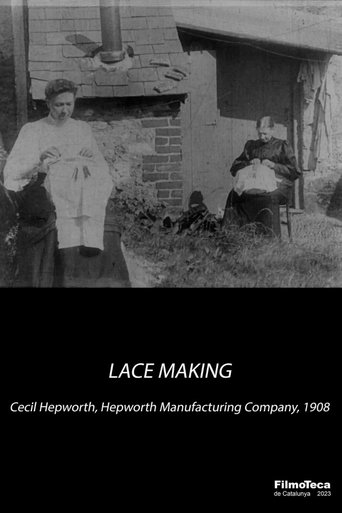
Lace Making 1908
The lacemakers of Honiton, a small town in Devon, who have made bobbin lace since the 16th century.
The lacemakers of Honiton, a small town in Devon, who have made bobbin lace since the 16th century.

In this comedy we see a fellow giving orders to the cook to put plenty of garlic in his food, and she complies with his wishes by giving everything an extra dose of the unpleasant ingredient. The first victim of the fumes is a dog that is seated beside the table, and when the fellow blows his breath on the animal he falls over unconscious from the effects. Next he prostrates a street cleaner and a painter perched on a ladder, as well as a woman in charge of a newsstand. They all succumb and fall over unconscious on the ground. He enters the subway and meets a man coming up the stairs, and when the latter gets a whiff of the garlic he too, goes down in a heap. Entering the car in the underground road he proceeds to waft the strong odor over the passengers, with the effect that each in turn goes down and out on the floor of the coach. When he reaches the next station he alights, leaving the car looking more like a hospital than anything.
Only the visual elements are known to survive from this 1908 recording of a duet from Franz von Suppe's early one-act operetta. As is usual with these recordings, the principal performers take center stage, face the camera directly, and let fly. There are other cast members in the background, providing a drunken chorus.
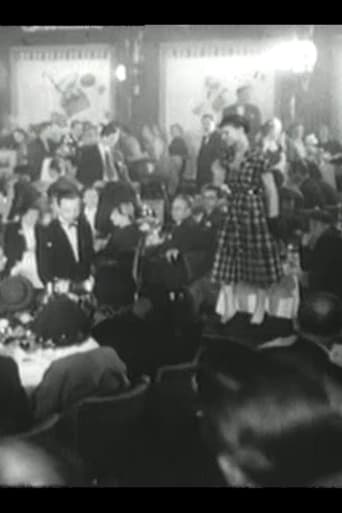
Peter Elfelt filming fashion.
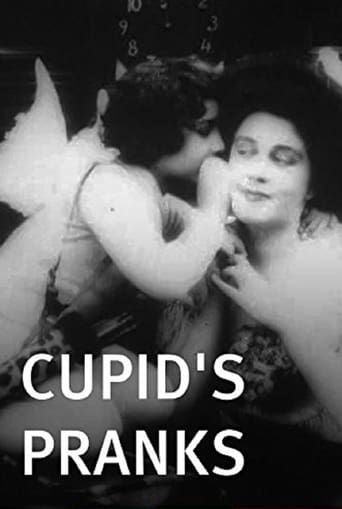
After receiving a scolding for falling asleep on the job, Cupid is sent out in search of potential lovers to unite. While flying over a city, he finds a ballroom dance and identifies a likely couple. He is successful in getting them to meet, but many obstacles still stand in the way of Cupid achieving his goal for them.
A mischievous duke comes across a drunkard in a town square, and decides to pull a practical joke. He has the drunkard carried to the ducal palace and dressed as a nobleman, where he is made to receive courtiers. A banquet is prepared for the fake nobleman, who is too far gone to understand the situation, and unusual things seem to begin occurring. When the drunkard attempts to get more to drink, the bottle magically grows to giant size and disappears, so the duke's servants bring in a large funnel and fill the drunkard up, with his stomach swelling up like a balloon to fit. The duke's doctors work to deflate him back to normal. The drunkard tries to get some sleep, but the paintings on the walls come to life, showing him all sorts of scenes of people drinking merrily.
1908 French short silent film directed by Georges Méliès, which is currently presumed lost.
A fraudster is at work in his laboratory, where he pretends to make synthetic diamonds.
A trip from Stockholm to Gothenburg by two canals.
Short film about the carnival activities in Mainz, Germany.
Lost film, one of several adaptation of Shakespeare's play from the silent era. Do not confuse with Mario Caserini's version, released in May of the same year.
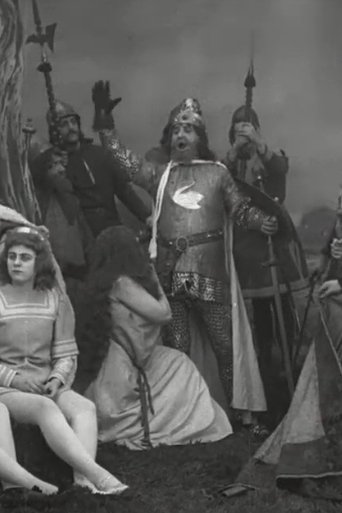
Tonbild (Sound Picture) for the duet "Wenn ich im Kampf für dich siege" from the first act of Richard Wagner's opera "Lohengrin".
In this interesting little drama we are brought in contact with a man who is one of the highly respected citizens of a little mountain village, while in reality he is living a Dr. Jekyll and Mr. Hyde existence. We see him leave his home and go on his way up into the mountain to hunt. When he reaches a remote part in the forest he takes a black cape and mask from under a rock and puts them on, thus concealing his identity.
Two singers do not enter and take up their position in the center of the stage. Instead, the camera discovers them, the woman on her balcony and the man just outside, whereupon they launch into the duet "Liebchen Komi In Mein Stubchen".

A girl walking in the woods is captured by an evil dwarf. He takes her home and forces her to keep house for him. Thanks to a beautiful fairy and the mice she takes care of, she escapes.
For the benefit of those who are not fortunate enough to travel and enjoy the beauties and customs of different countries, a film of this kind is an innovation, for it takes us on a boat down the beautiful Imperial Canal of China. If we were there in reality it could not be much more enjoyable than this picture, which favors us with a wonderful view of the famous wall of China as it stands to-day in a stage of decay, a monument to a famous fanatical nation.