CBS Morning News

CBS Morning News 1970

1

CBS Morning News is an American early morning television news program CBS. The program features late-breaking news stories, weather forecasts, and sports highlights. It is anchored by Anne Marie Green, who also serves as anchor of CBS's overnight news program Up to the Minute. The program is broadcast live at 4:00 a.m. Eastern Time, and is transmitted in a continuous half-hour tape delayed loop until 10:00 a.m. ET, when CBS This Morning begins in the Pacific Time Zone. The program usually airs as a lead-in to local morning newscasts on most CBS stations, although in the few markets where the CBS station does not produce a morning newscast, it may air in a two- to three-hour loop immediately before the start of CBS This Morning. The show is updated for any breaking news occurring before 7:00 a.m. ET, while stations throughout the network will join CBS This Morning in all time zones past that time at their local discretion or network orders for live coverage.

1970

Give-n-Take

Give-n-Take 1970

1

Give-n-Take is an American television game show which ran on CBS from September 8 to November 28, 1975. Jim Lange hosted, with Johnny Jacobs announcing. The series, which replaced Spin-Off, ended after 60 episodes.

1970

The Job

The Job 1970

1

The Job is an American reality-competition television series that aired on CBS from February 8 to February 15, 2013 at 8:00 pm Eastern/7:00 pm Central. Hosted by Lisa Ling, the series featured contestants competing in various challenges for a chance to win "a dream job at their dream company". A pilot order for The Job was placed in March 2012 and the series was picked up in May for an expected midseason debut. Michael Davies and Mark Burnett served as executive producers. The series was canceled after two episodes aired.

1970

Amateur's Guide to Love

Amateur's Guide to Love 1970

1

The Amateur's Guide to Love is an American television game show, created by Merrill Heatter and Bob Quigley, that ran on CBS from March 27 to June 23, 1972. Gene Rayburn was the emcee, while Kenny Williams was the announcer. The theme was written by Mort Garson, of Our Day Will Come fame. Each episode began with Garson's theme song, set to shots of a van emblazoned with the Amateur's Guide to Love logo driving around southern California, with scenes of men and women falling in love with each other. As the van travels around, host Gene Rayburn sets the scene for the game show: Afterwards, the show would then cut to the studio, where announcer Kenny Williams would introduce this weeks' panelists, and Rayburn.

1970

The Body Human

The Body Human 1970

1

The Body Human was a series of specials produced by the National Geographic Society and telecast by CBS, between 1977 and 1984. They were produced and directed by Alfred R. Kelman, who was nominated for an Academy Award in 1966 for The Face of a Genius. Unlike most National Geographic specials, this series did not concentrate on exploring nature or the origins of man, but, as the name implied, on aspects of the human body, from plastic surgery to sexual function. Alexander Scourby was the narrator. The series was nominated for and won Emmy Awards.

1970

Bicentennial Minutes

Bicentennial Minutes 1970

8.00

Bicentennial Minutes was a series of short educational American television segments commemorating the bicentennial of the American Revolution. The segments were produced by the CBS Television Network and broadcast nightly from July 4, 1974, until December 31, 1976. The segments were sponsored by Shell Oil Company. The series was created by Ethel Winant and Louis Friedman of CBS, who had overcome the objections of network executives who considered it to be an unworthy use of program time. The producer of the series was Paul Waigner, the executive producer was Bob Markell, and the executive story editor and writer was Bernard Eismann from 1974 to 1976. He was followed by Jerome Alden. In 1976, the series received an Emmy Award in the category of Special Classification of Outstanding Program and Individual Achievement. It also won a Special Christopher Award in 1976. The videotaped segments were one minute long and were broadcast each night during prime time hours, generally at approximately 8:57 P.M. Eastern time. The format of the segments did not change, although each segment featured a different narrator, often a CBS network television star. The narrator, after introducing himself or herself, would state "This is a Bicentennial Minute," followed by the phrase "Two hundred years ago today..." and a description a historical event or personage prominent on that particular date two hundred years before during the American Revolution. The segment would close with the narrator saying, "I'm, and that's the way it was." This was an offhand reference to the close of the weeknight CBS Evening News with Walter Cronkite, who always ended each news telecast by saying, "And that's the way it is."

1970

The Johns Hopkins Science Review

The Johns Hopkins Science Review 1970

1

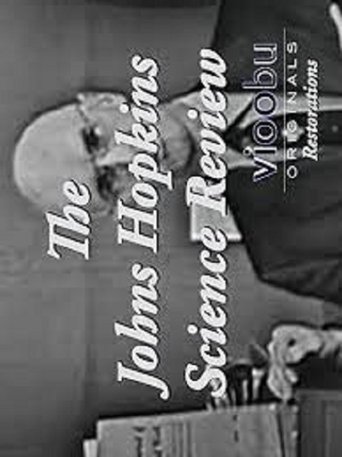
The Johns Hopkins Science Review is a US television series about science that was produced at Johns Hopkins University from 1948-1955. Starting in 1950, the series aired on the DuMont Television Network until the network's demise in 1955. The series' creator was Lynn Poole, who wrote or co-wrote most of its episodes and acted as the on-camera host. In 2002, Patrick Lucanio and Gary Coville wrote that, "In retrospect, Lynn Poole created one of those unique series that allowed television to fulfill its idealized mission as both an educational and an entertainment medium." The original series was followed by three related series produced by Poole at Johns Hopkins University: Tomorrow, Tomorrow's Careers, and Johns Hopkins File 7. Johns Hopkins University ended its production of television series in 1960.

1970

Wacko

Wacko 1970

1

Wacko is an American half-hour children's television series that aired on CBS on Saturday mornings. The show was a live action variety show featuring skits and musical numbers. The show only had 10 episodes, from September 10, 1977 through November 12, 1977.

1970

The Tarzan/Lone Ranger Adventure Hour

The Tarzan/Lone Ranger Adventure Hour 1970

1

The Tarzan / Lone Ranger Adventure Hour is an animated television series produced by Filmation that aired on CBS during the early 1980s. The series consisted of reruns of Tarzan, Lord of the Jungle paired with new episodes of Filmation's versions of The Lone Ranger and, in the second season, The New Adventures of Zorro — at which point the series was retitled The Tarzan / Lone Ranger / Zorro Adventure Hour. The series ran from 1980 to 1982. Don Diamond who voiced Sergeant Gonzales in this animated series previously portrayed Corporal Reyes in Disney's 1950s live-action series of Zorro.

1970

CBS Sports Spectacular

CBS Sports Spectacular 1970

1

CBS Sports Spectacular is a sports anthology program produced by CBS Sports. The series began on January 3, 1960 as The CBS Sports Spectacular, and has been known under many different names, including CBS Sports Saturday, CBS Sports Sunday, Eye on Sports and The CBS Sports Show. The program continues to air on an irregular basis on weekend afternoons, especially during the late spring and summer months. Normally it airs pre-recorded "time-buy" sports events produced by outside companies, such as supercross or skiing competitions, or sponsored documentaries.

1970

Barker Bill's Cartoon Show

Barker Bill's Cartoon Show 1970

1

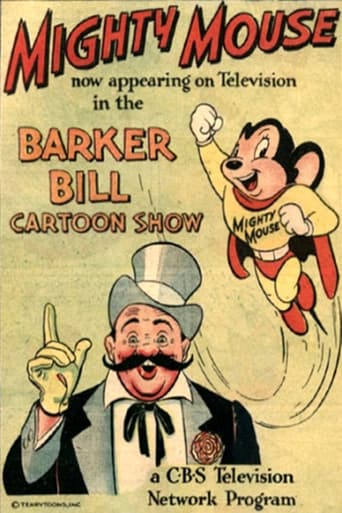
Barker Bill's Cartoon Show was the first network television weekday cartoon series, airing on CBS from 1953 to 1955. The 15 minute show was broadcast twice a week, Wednesdays and Fridays, at 5 P.M. Eastern, although some local stations showed both episodes together as a single 30 minute show. Barker Bill was a portly circus ringmaster with a long black handlebar mustache and dressed in the traditional costume - a fancy suit with white gloves and a top hat. The show was hosted by a stationary picture of the Barker Bill character with an off-camera announcer introducing the cartoons. The show featured old black and white cartoons obtained from Terrytoons. These were mostly older cartoons from the 1930s, like Farmer Al Falfa and Kiko the Kangaroo, not the more current and better known series such as Mighty Mouse and Heckle and Jeckle. Barker Bill did not appear in cartoons, but was briefly featured in a newspaper comic strip series. Terrytoons was the first major animation studio to give television a license to show its library of old black and white cartoons. The Barker Bill series was so successful, that that CBS offered to buy the Terrytoons studio, including its production facilities and library of cartoons. Paul Terry accepted the offer and retired in 1955.

1970

Go Toward The Light

Go Toward The Light 1970

7.50

Go Toward the Light is a 1988 television film starring Linda Hamilton, Joshua Harris and Richard Thomas. The film first aired on CBS on November 11, 1988.

1970

The Harlem Globetrotters Popcorn Machine

The Harlem Globetrotters Popcorn Machine 1970

1

The Harlem Globetrotters Popcorn Machine is a Saturday morning variety show featuring players from the basketball team the Harlem Globetrotters singing, dancing, and performing comedy sketches. Broadcast in 1974, it was produced by Funhouse Productions and Yongestreet Productions for CBS Productions.

1970

Faye Emerson's Wonderful Town

Faye Emerson's Wonderful Town 1970

1

Faye Emerson's Wonderful Town, also known as Wonderful Town, USA, is a 42-episode live half-hour variety television series which aired on CBS from June 16, 1951, to April 12, 1952 in which Faye Emerson visits various cities, mostly in the United States, to focus on the different kinds of music associated with each location.

1970

Pabst Blue Ribbon Bouts

Pabst Blue Ribbon Bouts 1970

1

Pabst Blue Ribbon Bouts was a television program that broadcast boxing matches from New York's Madison Square Garden featuring Russ Hodges, Jack Drees, and Bill Nimmo. Kinescopes of some of these matches were later re-broadcast under the title "Blue Ribbon Classics." In recent years, ESPN Classic has aired some of the bouts. Most Pabst Blue Ribbon fights can be viewed at TVS Boxing.Net.

1970

The Joseph Cotten Show

The Joseph Cotten Show 1970

1

The Joseph Cotten Show is an American anthology series series hosted by and occasionally starring Joseph Cotten. The series, which first aired on NBC, aired 31 episodes from September 14, 1956, to September 13, 1957. Four other new episodes were broadcast on CBS in Summer 1959.

1970

The Face Is Familiar

The Face Is Familiar 1970

1

The Face Is Familiar is an American game show which aired in color on CBS from May 7 to September 3, 1966. The show was hosted by Jack Whitaker and featured celebrity guests including Bob Crane, Dick Van Patten, Mel Brooks and June Lockhart. The series was primarily sponsored by Philip Morris' Parliament and Marlboro cigarettes, and their American Safety Razor and Clark Gum subsidiaries. The show was produced by Bob Stewart Productions in association with Filmways Television. Its theme song was a slightly-modified version of Brasilia, performed by Herb Alpert & the Tijuana Brass.

1970

60 Minutes II

60 Minutes II 1970

1

60 Minutes II was a weekly primetime news magazine television program that was intended to replicate the "signature style, journalistic quality and integrity" of the original 60 Minutes series. It aired on CBS on Wednesdays, then later moved to Fridays at 8 p.m. The original 60 Minutes continued airing on Sunday nights throughout the run of 60 Minutes II. The first edition of 60 Minutes II ran on January 13, 1999. Its final airing was September 2, 2005. 60 Minutes II was renamed 60 Minutes by CBS for the fall of 2004. CBS News president Andrew Heyward stated at the time, "The Roman numeral II created some confusion on the part of the viewers and suggested a watered-down version." The show was later renamed 60 Minutes Wednesday to differentiate it from the original 60 Minutes Sunday edition, but reverted to its original title on July 8, 2005, when the show moved to the 8 p.m. Friday timeslot, where it completed its run.

1970

Truth or Consequences

Truth or Consequences 1970

1

Contestants must perform an embarrassing stunt if they fail to answer a question correctly.

1970