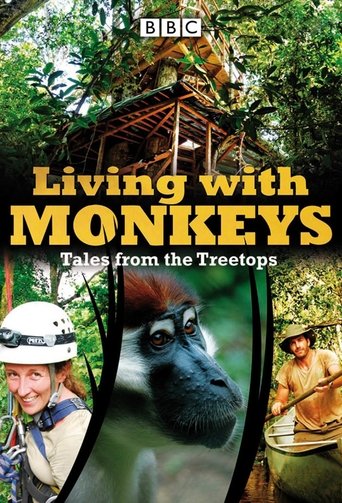
Living With Monkeys: Tales From the Treetops 2006
Adventurer Guy Grieve and primatologist Julie Anderson spend six weeks in the Central Africal rainforest, trying to save one of the world's rarest monkeys
Adventurer Guy Grieve and primatologist Julie Anderson spend six weeks in the Central Africal rainforest, trying to save one of the world's rarest monkeys

Holding Back the Years is a series looking at the experiences of growing older in Britain today, and how they've changed over the decades. Each episode sees a different 60 plus year old celebrity explore a particular aspect of getting old that interests and affects them most – from relationships and family to health and wellbeing, pensions and money, to simply looking in the mirror and seeing a ‘new' old you. Through meeting inspirational characters, unearthing long lost archive clips and visiting places that do amazing work helping the elderly, the series seeks to take an uplifting, look at a subject often ignored, while offering fantastic takeout for viewers of all ages.
Eureka is a British educational television series about science and inventiveness which was produced and broadcast by the BBC from 1981 to 1986. Devised and written by Clive Doig and Jeremy Beadle, the series told the stories behind the inventions of commonplace objects.
Children's Emergency is a British television documentary series. It follows the Children's Acute Transport Service, which is dedicated to taking critically ill children to specialist paediatric hospitals. Eight episodes were produced by September Films for the BBC, and it was first aired on BBC One between 4 May and 23 June 2010. The documentary follow the mobile teams as they deal with a range of paediatric mobile emergencies, including a 14-year-old who has had a heart attack, a baby boy who needs emergency heart surgery, a seven-year-old who has a seizure, and a 10-year-old girl who needs to move hospitals for a heart transplant.
We've Got Your Number is a BBC National Lottery game show that was broadcast on BBC One from 27 February 1999 to 15 May 1999. The programme was hosted by Brian Conley.
The Nigel Barton Plays are two semi-autobiographical television dramas by Dennis Potter, first broadcast on BBC1 in 1965 as part of The Wednesday Play strand. The first play, Stand Up, Nigel Barton, follows the eponymous character's journey from his childhood in a small mining community to winning a scholarship for Oxford, while the second play, Vote, Vote, Vote for Nigel Barton, sees him standing for Parliament as the Labour Party candidate in a by-election. Both plays develop themes and use dramatic devices that became hallmarks of Potter's later plays for television.
Business Breakfast is a business programme which aired on BBC One from 4 September 1989 to 15 September 2000.
Melvin and Maureen's Music-a-grams was an educational CBBC show about music which ran from 1992 to 1996 starring Sophie Aldred and Matthew Devitt. The show was rerun on CBeebies in late 2000s. Melvin and Maureen ran a music shop which sold "Music-A-Grams"- a recording of music for a certain purpose. Sometimes customers came asking for a particular music-a-gram. Melvin and Maureen also sang songs, and told stories to illustrate how musical instruments could be used to create different effects, or on a particular theme. The stories also involved a trio of soft toys, led by a teddy bear named Groovy Ted, who were on a constant quest for musical stardom. Episodes Pilot- Melvin and Maureen are set a riddle by Mr. Baggage; what is the funniest instrument in the world? The Wriggle- The gang try different types of dancing, then invent a style of their own. Dastardly Landlady- Melvin and Maureen use their music-a-grams to outwit their evil landlady Repercussions- Melvin learns that a pair of his bongo drums may be priceless. Whilst he turns the music shop upside-down looking for them, he and Maureen also showcase the vast range of percussion instruments. Orchestra-ra-ra Melvin and Maureen are asked to talk about the orchestra, but argue over who knows most
The Undercover Soldier is a 2008 BBC documentary which investigated bullying in the British Army in the wake of the Deepcut enquiry. For the programme, BBC journalist Russell Sharp went undercover as a soldier, enrolling in the army for six months basic training at the Infantry Training Centre, at the Catterick Garrison in Yorkshire. The one hour programme was shown on BBC One on Thursday 18 September 2008 at 9:00pm. The programme did not show any filmed evidence of ill treatment, although Sharp himself claimed to have witnessed several incidents of bullying. The documentary led to the suspension of five instructors based at the camp. The show attracted relatively low ratings and the BBC was criticised by serving soldiers for the way the investigation was conducted.
Captain Abercromby was a children's TV show that was on BBC Two in 2002-2003. Its cast was puppets.
BBC Look North is the BBC's TV news service for East Yorkshire and Lincolnshire, produced by BBC Yorkshire and Lincolnshire. The programmes are produced and broadcast from the BBC Broadcasting Centre at Queens Court in Kingston upon Hull, East Yorkshire with reporters also based in Grimsby, Lincolnshire and Lincoln. Peter Levy regularly presents the programme during weekday evenings at 6:30 with weekends, nights and bulletins on Daybreak covered by others from the news team. The weather presenters include Paul Hudson, Keeley Donovan, Lisa Gallagher. The programme can be watched in any part of the UK from Astra 1N on Freesat channel 967 and Sky channel 957, and in select areas on Virgin Media channel 858. The latest edition of Look North is also available to watch on the BBC iPlayer.
In-vision Ceefax was first shown in March 1980, originally in 30-minute slots and by mid-1983 it was a common filler during daytime downtime. Transmissions were originally billed on-air as Ceefax in Vision but daytime transmissions were not listed in the Radio Times until 7 January 1984, under the title of Pages from Ceefax.

Teddy Edward is a British television series for children. It was based on the books by Patrick and Mollie Matthews, about the travels of a teddy bear. The series of 13 episodes was transmitted in 1973, but often repeated until 1980. Each episode consisted of a story narrated by Richard Baker, illustrated by still photographs of Teddy Edward and his friends. Teddy Edward's travelling companions included Jasmine the Rabbit, Snowytoes the Panda and Bushy the Bushbaby. The series was directed by Howard Kennett. The distinctive theme tune was "Glad Gadabout" by Johnny Scott.
The Waiting Game was a Saturday night game show that aired on BBC One from 17 November 2001 to 15 June 2002 and it was hosted by Ruby Wax.
Castaway 2007 was a follow-up to the BBC series Castaway 2000 in which a group of people from the British public are "castaway" on a remote island. While in the 2000 series 36 men, women and children moved to a remote Scottish island for a year, this series featured 15 men and women from the British public who were moved to a New Zealand island for three months. The basic premise of a group of volunteers living as a community in a remote location remains, however this time the BBC promised an "exotic location, on the other side of the world". Another change since Castaway 2000, was that the castaways were voted off the island one-by-one, in a manner similar to other reality series like Big Brother. The prize for the winning castaway, which was Jonathan, was a trip around New Zealand with a friend later in the year.
