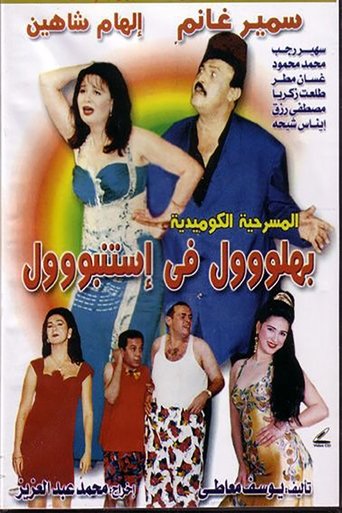
بهلول فى إستنبول 1970
Bahloul play in Istanbul Starring: Samir Ghanem Alham Shahin Talaat Zakaria Jihan Nasr Suheir Rajab Ghassan Matar Mohammed Mahmoud
Bahloul play in Istanbul Starring: Samir Ghanem Alham Shahin Talaat Zakaria Jihan Nasr Suheir Rajab Ghassan Matar Mohammed Mahmoud
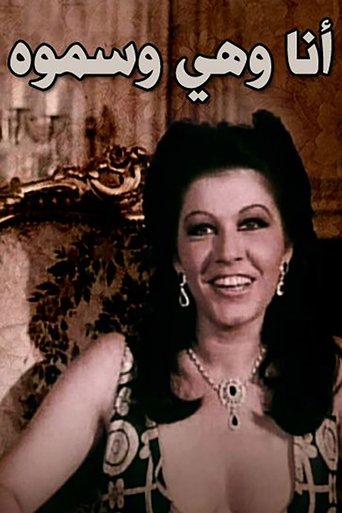
Professor Saad seeks to be a novelist but all his attempts to write a novel fail. His wife, Suhair, always complains of his inability to write. Suddenly, he receives a message from his cousin, the immigrant millionaire, announcing that he will travel and visit. Sohair and Saad are plotting to make Shaukat give them some of his money, are they successful?

Theatrical comedy review Manoor Ya Pasha starring Mohammed Najem Omar Hariri Samah Anwar Inas Makki Zia Al Mirghani
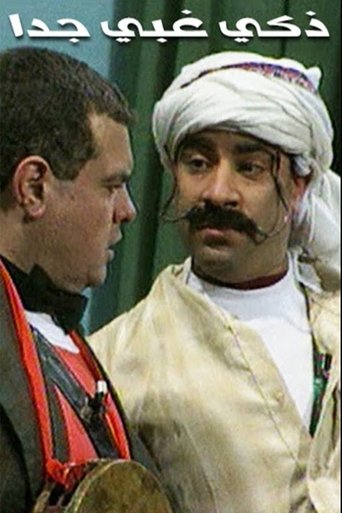
A comedy about the life of the young man Zaki, who dreams of becoming a famous singer and actor and in order to realize his dream is exposed to many interesting and exciting comedy situations
A comedy about the life of a man married to four women, who falls in love with his teacher who learned to read and write; which angered his four wives. what is going to happen?

Mohamed Reda & Hassan Al-Roubi & Ahmed Ammar & Amal Diab & Mohamed Tantawi & Rashad Othman & Laila Sabounji
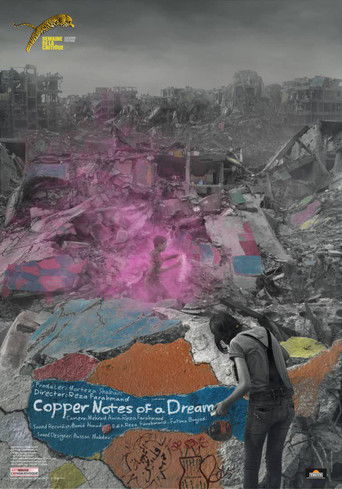
10 year old Molouk who seeking to preside over surviving children lives her friends by pulling out copper write from ruined houses.

Salma Shamel’s Those That Tremble as if They Were Mad is a wry lamentation of a future not grasped. In the aftermath of Egypt’s 2011 revolution a government committee was set up to compile an archive of the revolution’s events, only to be dissolved following a coup. Through a parade of the committee’s ephemera of CD-ROMs, certificates and contracts, Those That Tremble mourns what could have been, to a soundscape of mass distress.

In the prosecution, Jalal Salah is accused of stealing his car, denying Nadia's presence with him in the incident for fear of the oppression of her brother. Jalal sees that he is withdrawing from his car. His statement from the prosecution provided that Salah left the town and his father. At the same time, Hamza Salah is not hiding in his home. He tells him that Jalal is not serious about his relationship with her and her relationship with Hamza is growing. Jalal knows that Salah has not left the town and ordered his men to kill him. Hamza decides to leave the town. At the time, Jalal is able to attack Laila, killing him and handing himself over to the police.
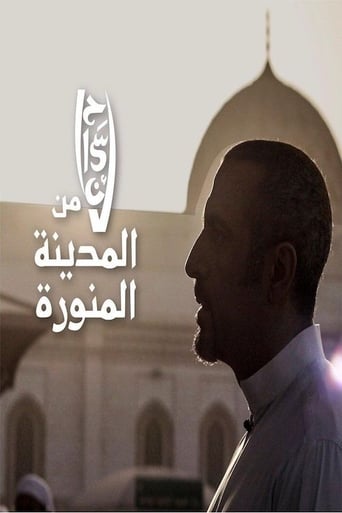
Ahmed Shukairi's visit to Medina takes on a different character, where he tries to explore the great efforts that have been made to develop it while preserving its heritage at the same time.
Salah has always been a shepherd. It is a fate that was chosen for him by his parents when he was still a child. Moving constantly between pastures in the mountains and on the plains of the Moroccan Atlas mountains with his family, he has handed down traditions and knowledge to his children, who take care of the herds today. It is a nomadic life made up of sacrifices, fatigue and long journeys through unspoilt landscapes in an often hostile climate. The young people carry out the roles that life has assigned to them, dreaming of moving to the city and awaiting an uncertain future.

In Sudan, music is a central part of daily life. At the same time, young musicians struggle to find society's support in pursuing their passion the way they want. One organization called "Yalla Khartoum" strives to counteract by creating safe spaces for young artists to experiment in. This short documentary was shot during one of their workshops.

An experimental short film explores the concept of identity, its limitations and how it is formed Through social and cultural contexts. It also addresses the idea of death As an inevitable event and destiny.
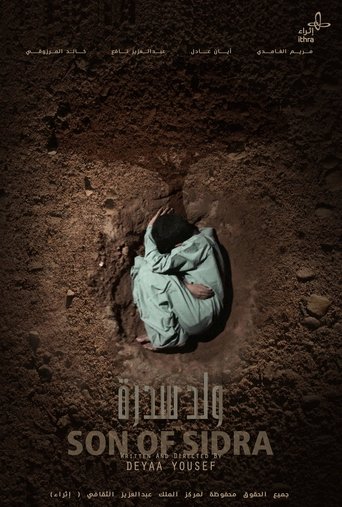
An old town id under the affection of the mythical story of the Tree of Sidra.
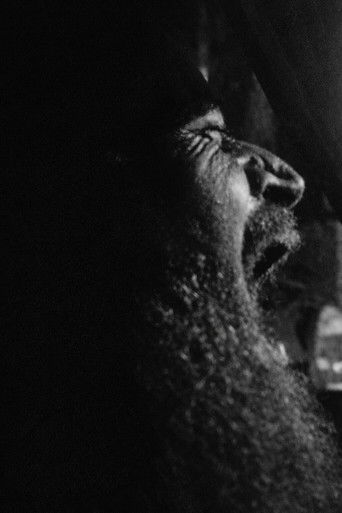
In this two-part tour through the streets of Lebanon, a colorful Palestinian cab driver offers offhand insight into the region’s fraught political and social climate through boisterous serenades and excitable outbursts.
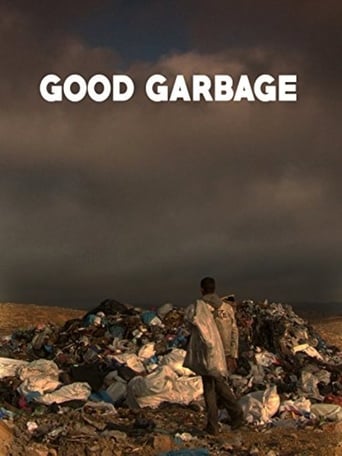
The Hebron Hills garbage dump serves the Israeli settlements in the area and is a source of an eked-out livelihood for 200 Palestinian families from in and around the nearby Palestinian village.
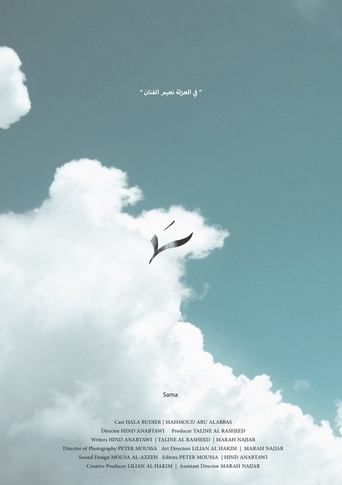
Sama is in denial over the recent death of her twin brother, Mousa. On the first birthday anniversary following his passing, she finally decides to visit his grave to fulfil an old promise. However; the cemetery guard objects to her staying past sunset. Sama sneaks back in determined, least expecting that her second encounter with the guard, is her wake up call to submit to her loss.

During a clandestine tour in Italy, an interview between an immigrant and two journalists takes an unexpected turn. The disclosed events prove to be dreadful.

Palestine in the Eye chronicles the profound impact of Hani Jawharieh’s death for the PLO Film Unit. The film reflects on his life through interviews with family, colleagues, and his own cinematography, including the moment of his death while filming for the Unit in 1976. Although the film has later been attributed to Mustafa Abu Ali, the Unit’s method of work was to describe everyone as a collective of “workers,” and we see this in the film titles, which collectively list the names of all those who participated as a non-hierarchical collective. Through this reflection on Jawharieh, we are offered an understanding of the workings of the Palestine Film Unit and its international connections.

An Egyptian woman is trying to look after her four children, especially in the lead-up to and aftermath of her divorce from their father. However, over time, the circumstances around her gradually change on all levels.
