
The Celebration of Erwin Koloczek 2007
A memorizing documentary, is inspired by the documentary films - the specific genera that is commonly used to mythologize the heroes of mass culture in order to emphesize their celebrity status.
A memorizing documentary, is inspired by the documentary films - the specific genera that is commonly used to mythologize the heroes of mass culture in order to emphesize their celebrity status.
A tribute to a Polish jazz drummer, Jacek Olter (1971-2001). Olter played in many bands connected to so called 'yass' scene and was considered one of the best young talents in the genre. Though presently not as blossoming as in previous decade, Yass (a term coined in the 1980s) was a musical amalgam of various styles, with strong jazz/improv roots and influenced by punk rock, folk, electronica.
The documentary presents the figure of doctor Zygmunt Klukowski, who was not only a great doctor, but also a social activist, writer, soldier and regional historian. His books describing the years of Nazi occupation of the Zamość region are an invaluable testimony of the horror of those days. After the war Klukowski was arrested for his activity in the underground movement, but was eventually granted amnesty and appreciated by the public.
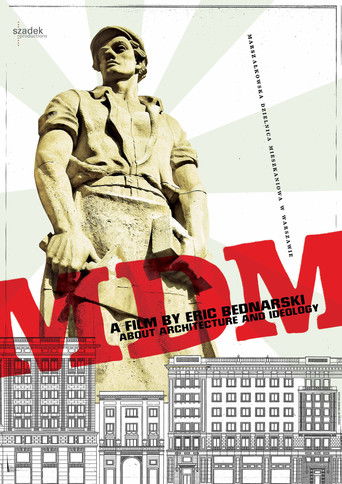
MDM explores the relationship between architecture and ideology by focusing on one Warsaw neighbourhood. The Marszalkowska Housing District was one of the first and most famous of Poland's 1950s Socialist-Realist housing developments. Conceived on a monumental scale as a model of socialist planning and an architectural showpiece for the new Soviet-backed Communist regime, it rose up from the ruins of a city almost completely destroyed in World War II.
The extended television version of the film 83 Zlota Street, offering an expanded look at the various colourful characters introduced there.
Artur Zmijewski, a Polish artist born in 1966, explores social norms through films and photographs by creating unusual situations and documenting participants’ reactions. His work often addresses long-term trauma from historical and sociopolitical events, focusing on marginalized groups and popular beliefs. In “Sculpture Plein-air. Swiecie 2009,” Zmijewski organized workshops where Polish artists collaborated with steel workers in Swiecie to create public sculptures, inspired by 1960s collaborations in Elblag. This project questions the possibility of overcoming current social and political divides.
Wilderness in the Bieszczady mountains, with the nearest shop eight kilometers away. These are the conditions in which Zbyszek who burns charcoal decided to live. He treats hard work as a kind of atonement for his past deeds. Three tar makers who worked with him, including his son, are already dead. The man sees a link between their deaths and his deeds. His next companion is black Gustaw whose dream is to study medicine. Will he turn out to be the title fourth man?
An analysis of the space of the Stadium of the Decade. Formerly the site of the most important sporting events and state celebrations, since 1989 it has become one of the largest markets. The director, presenting one day in the life of the Fair Europe, shows his multi-level construction and the hierarchy of sellers, often coinciding with the topographic layout of the stadium and national affiliation - mainly Polish or Vietnamese, though there are also other visitors from outside the eastern border. The film creates a mosaic of stories told by traffickers, policemen and local criminals. Their accounts show the realities of stadium life - the day of work begins at night, and besides trade, it is filled with numerous thefts, frauds and ethnic tensions. The film also uses archival material from the Documentary and Feature Film Studios, showing the life of the stadium in PRL.
In February 1942, aerospace doctors Zygmunt Rascher, Zygfryd Ruff and Wolfgang Romberg conducted a study on the issue of high altitude flight at Dachau Concentration Camp. Over 200 prisoners were used in these experiments and about 80 of them lost their lives. The document begins with the reading of the letters by Zygmunt Rasher to the Reichsführer on experiments; They contain accurate descriptions of death and autopsies. From the documentary we learn that the first man who crossed the space was an anonymous merchant of Jewish nationality - it was in Dachau, 19 years before the Soviet space flight Yuri Gagarin.
A short documentary about women, cats and children and the relative importance of each to the other.
A documentary history of the inhabitants of a Warsaw tenement house at 83 Złota Street, the so-called Bermuda Triangle, or Pekin if you prefer. Most of these people have lived in the tenement house for several decades. Now, however, they have all received eviction orders. Due to its poor technical condition, the building is to be demolished and replaced by a hotel or a huge shopping centre.
Cichociemni ("the Silent-Dark Ones" or "The Unseen and Silent") were elite special-operations paratroops of the Polish Army in exile, created in Great Britain during World War II to operate in occupied Poland.
The film is set in the Bialystok region on the holy mountain of Grabarka, the areas of Siemiatycz, Milejczyc and others. The protagonist is John Trochimczyk, who driven by misfortune decides to carry the cross before the feast of the Saviour and dedicate it to Grabarka to rescue his sick wife. With a wooden cross provided, he meets along the way local people and all the time is approaching the sacred mountains of Grabarka.
A short film focusing on the lives and problems of the elderly in Poland circa 1986.
A portrait of the employees of the Palace of Culture and Science in Warsaw. The film shows one night, during which we witness the duty of its guards, cleaners, guards, elevators. It's a pretext to listen to their stories about the Palace, its history. Everything happens while the wedding of the daughter of the Palace's guards is taking place in the background in the PKiN staff canteen.
Prominent heart surgeon Zbigniew Religa talks about his fears and hopes he had towards this operation, which was the first one successful heart transplant in Poland, made under his supervision. The doctor talks with great respect and affection about his patients and colleagues.
To say of Kantor that he is among Poland's most outstanding artists of the second half of the twentieth century is to say very little. Kantor is to Polish art what Joseph Beuys was to German art, what Andy Warhol was to American art. He created a unique strain of theatre, was an active participant in the revolutions of the neo-avant-garde, a highly original theoretician, an innovator strongly grounded in tradition, an anti-painterly painter, a happener-heretic, and an ironic conceptualist. These are only a few of his many incarnations. Apart from that, Kantor was an untiring animator of artistic life in post-war Poland, one could even say, one of its chief motivating forces. His greatness derives not so much from his oeuvre, as from Kantor himself in his entirety, as a kind of Gesamtkunstwerk that consists of his art, his theory, and his life.
In photos and films, Praga resembles a small town rather than a district of Warsaw. One may see service facilities, sometimes only signboards and few craftsmen doing jobs becoming a thing of the past. Grinders, engravers, tailors, blacksmiths, saddlers rarely meet their customers. The symbol of the passing era is a cabman portrayed against high and modern blocks of flats. In the backyards of Praga, mangles are still visible. It is a thing of women, similarly to beauty and hairdressing salons. A lighthouse keeper still lights gas lamps, but the bygone world slowly dies out.
Portrait of a family emigrating to Sweden.
Abstract, geometric forms, became the basis for the most outstanding works of the avant-garde sculptor Katarzyna Kobro. With her 'Spatial Compositions', she created her own artistic language, with which she aroused a lot of criticism, which was based on the traditional assumption that a sculpture should be a compact, modelled mass. However, the task of "Composition" was to shape forms that were to come into being. Kobro, however, still wanted to change the space surrounding people with her own art.
