He Said Without Moving 1981
A character study showing the dissolution of the characters sense of self. The structure is based loosely on a pantoum structure in poetry.
A character study showing the dissolution of the characters sense of self. The structure is based loosely on a pantoum structure in poetry.

Dan and Carole meet and confess to each other, their desire to leave everything, and to die. They decide to perform crimes to live without paying. But one day : they commit a murder.
A solitary man's mind, becomes a battlefield of overlapping images and voices. As he spends the day in his house doing an assortment of domestic jobs: cooking, eating, reading, writing and bathing, images of war and death enter the man's mind. The anonymity of life can haunt you if you think on it too much.
The story of Glen Davis, a shale oil town built to supply oil for the Navy in World War II. After the war the township that grew with the works struggles for survival. It is the site of the longest stay-in strike in Australian Labor history. The town finally died in 1952. Each year its former inhabitants return to picnic in the ruins.
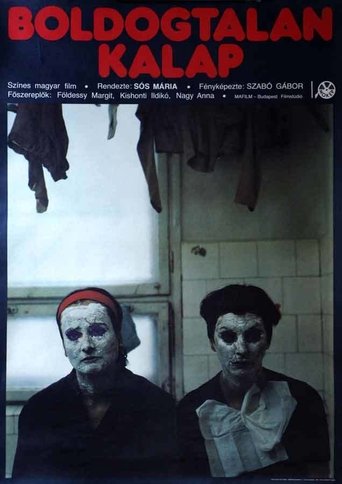
Three divorced women (Ildiko Kishonti, Anna Nagy, and Margit Foldessy) square off to face a new existence as single parents with residual hang-ups from their failed marriages. One woman gets involved with a man who is still symbolically, if not umbilically attached to his mother, the second woman makes half-hearted attempts to get back together with her husband. The third woman calls her husband to say "Happy New Year" and he interprets the gist of her message as a veiled suicide threat -- rushing her quickly into a hospital for treatment. The mishaps and misadventures of the women are a telling commentary on the assumptions that marriage brings with it, and how to gain independence in spite of oneself.
The heroine in this domestic drama is a woman with middle-class angst (Jeanne Goupil) married to an acerbic film critic with little in the way of interpersonal skills. The woman has had it with endless, meaningless twaddle from each of her husband's friends about what they think, feel, or do. She needs something more than what she faces each day, and finally blows up at her husband like a pressure cooker venting steam. The aftermath is not without its effects on both husband and wife.

Official entry to the first Metro Manila Film Festival in 1981 directed by Jose Yandoc and starred Ramon Revilla, Anthony Alonzo, Isabel Rivas, Rosemarie de Vera, Eddie Garcia, George Estregan, Nick Romano, Arnold Mendoza, and Laarni Enriquez.

Art film part of the REWIND + PLAY, An Anthology of Early British Video Art box-set.
Art film part of the REWIND + PLAY, An Anthology of Early British Video Art box-set.
The various phases of work in a spinning-mill, and the harsh working conditions of the women spinners, cause them physical pain and breathing diseases, not compensated by low wages.

Karl Kels' first film is a playful short piece comprised of shots of haystacks in the countryside. Quick repetitions of frames and the dance-like rhythm in which the frames are combined create an illusion of movement within the single shot in which no actual movement takes place, save for one passing car. The combination of different images in short sequences forces a new reality upon the haystacks, making them move in every possible direction. Short as it is, this debut already puts its finger upon some of the characteristics that have remained of great importance throughout Kels' entire work so far: the inseparable world of the single frame and time as an artistic controlling device.
At the end of Koryo Kingdom, Ra Young-Kyun attempts to deprive Yongmun secret martial art skill book, which explains the martial art of Yongmun Buddhist Temple, to get rid of all of the warriors who stay in the Buddhist Temple. The great Buddhist priest Ji-Deok of the Yongmun Buddhist Temple gives his best disciple named Nam-Hee the book. Another disciple named Hae-Cheon hurts Nam-Hee by Ra's plot, and looks for the book, but Yoo Cheong-Eun has already stolen the book and hides himself. Hae-Cheon loses his left hand arm to be expelled. Nam-Hee loses not only her teacher but also the book, and becomes pregnant to deliver her baby with Cheong-Eun's help. Cheong-Eun is killed by Ra and his followers, and relays Nam-Hee the book just before she dies. Nam-Hee defeats all of the warriors, who try to get the book, with her excellent martial art, and then leaves the place together with her daughter.
In the fight against Ma Sa-Keol, or the head of gang, to protest Ma's exploitation at a business district at Hong Kong, a Korean youth named Han Seok is killed by Ma's subordinates. Since then, Wang, who is the owner of a store of business district, has been bothered by Han Yong's careless action. On the other hand, Ma threatens Su-Ryeon, or the owner of a ranch at new development site, to deprive him of the ranch, while both Han Yong and Wang are chased by Ma and his followers to go to the ranch. Han Yong, who is Han Seok's younger brother, disguised himself as a chief cooker at a restaurant to look for the one who killed his elder brother. The owner of the ranch is also Korean. In the fierce fight at the ranch, they defeat Ma and his followers.
A guitarist of lower class musical troupe fails to get a job owing to his humble guitar. One day, he earns as much as 83,000 won, and is pleased to go back to his home. On the way to home, he helps Ok-Hee and her mother. But, Ok-Hee's mother steals the money and flees. On the following day, Ok-Hee asks him to return her mother. He and Ok-Hee take a trip here and there, and share sorrow and pleasure with some isolated persons. Ok-Hee steadily forgets the image of her mother who committed wrong things. Instead, Ok-Hee imagines good shape of her mother, which becomes her dream and life objective. In their journey up to the island Jukdo, Ok-Hee discovers that only her mother's light pink colored skirt is left.
An expert detective Park inspects a gang of Jang Do-Il and Ma Jin-Du, who acts mainly at Inchon port' piers. Both crime groups make every effort to take power. Jang Do-Il asks Dr. William to make remote control robot (artificial man) to defeat Jang Do-Il. Jang keeps three robot, that is, Il-Keol, Ee-Keol and Sam-Keol, to attack Ma's agitating post unexpectedly and deprive Ma of the smuggled goods. The three robots become powerful so that the police starts to inspect in full scale. Dr. William intends to move the robots to Hong Kong. Being aware of such a plan, William's female secretary informs the robots that they have been wrongly used for the crime. Upon hearing such an information, the robots rush to William to destroy his plan.
Do Do Hae is a confident and outgoing young woman who is the daughter of the chairman of the Sindongyang Corporation. She works to help abused women. Ahn Min Bok is a veteran cop who lives for his daughter Yeong Hee. But Yeong Hee falls in love with Jung Eui Han who spends nights at the police station after curfew. Eui Han begins to work as a security guard at the Sindongyang building. He gets into an argument with Do Hae. She tries to get back at Eui Han but fails again and soon finds herself attracted to him. When she finds out that Eui Han and Yeong Hee are engaged, she bids them a happy marriage while hiding her tears
"The last piece I made as the Arts Council's video artist in residence at Brighton Polytechnic. In it, I attempt to hold back time by clicking my fingers; or perhaps I am cueing the next clip. It was the beginning for me of a theme which I am still concerned with in my current work. There is narrative in the form of a running joke and there is an implied drama, running alongside a very matter of fact presentation of my recent video lecture trip across Canada." – Neil Armstrong
Jennifer, Where Are You? is structured by a speech-act, a constant proleptic call, a man’s voice which has been edited and recut into a repetitive and pervasive presence. The insistence of this male voice, which repeats the phrase “Jennifer! Where are you?” every 30 seconds, parodies the authority conceded to voice-overs in the cinema. The voice is patriarchal, relentless, and runs the entire length of the film. Cut-aways to a small girl, glancing at the camera as she plays with lipstick and matches, reapportion the relation between patriarchal phonocentrism and masculine gaze. But is this small child subject to either? No. Not really. There she is, hiding in plain sight–ours, not ‘his’–a ‘purloined subject’ successfully evading subjugation through response or acquiescence. ‘Jennifer,’ whoever she might be (a cipher, a pseudonymous textual marker of gendered cinematic presence) is never apprehended, and the film, for all of its suspense, simply ends.

