
When There’s nothing left to do 2016
Five boys in Prishtina waste away their evenings away doing things only to fill up the space of time.
Five boys in Prishtina waste away their evenings away doing things only to fill up the space of time.
This film is dedicated to the girl who died in June 2016 in Prizren, Xheneta Gashi. This film is about the kids living in the same circumstances as Xheneta did, and also it’s about the miserable economic situation of Kosovo.
Ajshe is the same age as my grandmother. Ajshe’s story is nearly identical to the story of most women her age. In the past, the present and the future, one has many choices but when it comes to marriage, there can be only one.
This film is about the domestic violence. A boy tells about the violence he experienced and is still experiencing in his family; where the father violates physically his mother.
A chronicle of the parallel school system in Kosovo during the 1990’s when Albanians were expelled from learning institutions by the occupying Serbs. The filmmaker Bukoshi interviews former students who vividly recall the extraordinary and often dangerous lengths they went to pursue a basic education.
Year 2005 Kosovo has been liberated 10 years ago by NATO forces under the leadership of USA. NATO forces now have complete control of the security situation in the country, but are not physically present in every town in Kosovo. Many Kosovars who have been waiting for liberation by NATO and the United States after the war are desperate when they realize that liberation bu itself will not solve all their problems, but can solve only the problem of security. There are those who are still waiting.
Consequences flowing from the consequences. Some women raped during the war in one village in Kosovo from Serbian army, cope with the consequences of rape, several years after the war. Lushe a woman raped during the war confessed for the newspaper about what happened during the Kosovo war. Village troubled by this news, it brings new consequences as e result of the phenomenon.
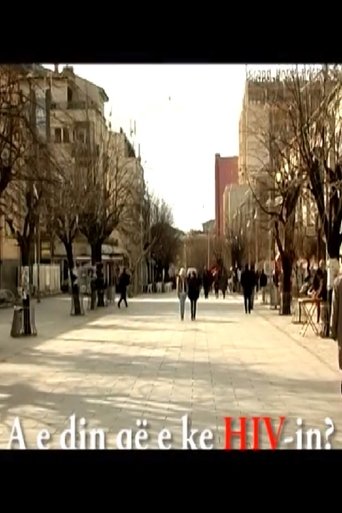
Dardana meets an interesting DJ in a party, and she spends the night with him. The next day she meets her friend that tells her that the DJ is infected with HIV. Her weeks and months pass and she finds out the truth when it’s late…
A pianist infected with HIV, falls in love with a young ballerina with whom he wants to have a serious relationship. They decide to spend the night together, but with the girl insisting to have non protected sexual relations the pianist has doubts about the right choice…
The film’s title “Are You Everybody?” was a common expression, and first greeting to fellow Kosovan people, when they saw each other for the first time after the war. It was a quick way of finding out whether there was anybody lost from their family. In June 1999 Lala Meredith-Vula (whose father is from Kosova) was invited by the British Red Cross to go in to Kosova shortly after the liberation and end of the NATO bombing. She witnessed the country torn and desolate gradually come back to life again. It is an artist’s deeply personal study about people surviving adversity and carrying on. The film shows the indomitability of the human spirit.
The story takes place during the time of the last war in Kosovo, within the basement of a house, which turns out to be the home of a Serbian policeman. He holds isolated an Albanian doctor called Agron. Agron`s only goal is escaping from the basement and joining his family. But he will be faced with staggering psychological challenges from the Serbian policeman who keeps Agron within the basement through violence, for a very special reason.
Phoebe, a successful writer and activist, lives in isolation in her apartment with her daughter, Aria, during the pandemic. After a normal day of reading comments and statuses on Facebook, tensions begin to rise when Aria insists on going outside. Phoebe, scared and filled with doubt, experiences a moment of panic when she thinks Aria has run away. After a period of searching, Phoebe finds Aria and, to relieve the tension, begins to jump out of the window, leaving everything behind.
Elda, a 20-year-old girl passionate about taekwondo, faces a great challenge when she enters a duel against Celina, a powerful rival, despite having a broken left hand. Despite the pain and fear, she finds the strength to continue. With courage and determination, Elda secures victory, but her greatest act comes after the match, when she extends her hand to Celina, showing that true strength lies in respect and compassion for the opponent.
On the anniversary of his wife's death, Anton prepares the ritual of distributing red roses, but a group of children steals his bag. Without the courage to continue, he decides to leave a rose with his neighbor Sofia, a woman who had warmed his life. Desperate, he stops in front of her house, but Sofia, touched by his sadness, sends him a cake with a warm note. The cake reminds Anton that, sometimes, small gestures of kindness can replace roses.
When the municipality of Lipjan decided to remake the river that runs through the village of Janjeva, it was done without consultation with its inhabitants. We tried to get answers from the officials but couldn't get through, we were, however, able to see the construction. In lieu of a dialogue, this is our comment on what they did.
Dorina is an average girl with an obsession about her looks. Everything changes when she is faced with invasive attention that leads her to transform against social norms.
Molly (30), a very successful woman in life and career, married to a man but meanwhile had an affair with a girl (Shane 34) ,where she found herself and her freedom in the masochistic love they experienced together. While everything was going well, Molly decided to express her feelings to Shane and leave her husband for her. Shane was afraid of serious relationships, gets cold feet and decides to leave Molly, in a way that makes Molly believe that she is dead.
A young couple, struggling with infertility, faces family pressure to adopt a boy, but when the only boy available is disabled, they must choose between tradition and the love that transcends it.
"Gjuha e re" is an attempt to capture the communicative exclusion experienced by an Albanian immigrant in Greece. It is minutes of anger towards the dominant languages of a place. An untranslated poem with "bad accent" and "fake" words.
Katërmbëdhjetë vjeç dhëndër (English: A Bridegroom at Fourteen) is an Albanian play by Andon Zako Çajupi. The four-act comedy was written in 1902 and published posthumously in 1930. The work, which was considered a critique on the custom of arranged marriage, was adapted to film in 1987.
