Maypops 1971
A boy, a girl, several horses, a mother, and a nursing baby provide the central focus for a study of movement.
A boy, a girl, several horses, a mother, and a nursing baby provide the central focus for a study of movement.
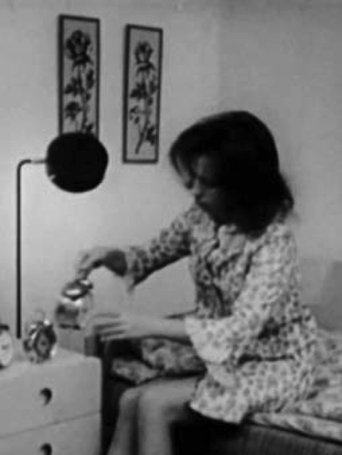
A documentary about the girls at Marabou and their work situation.
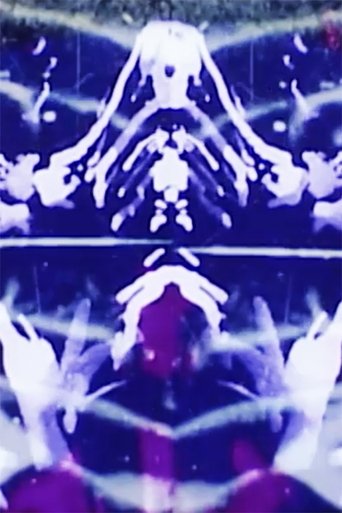
Phosphene features colorful negatives of erotic imagery. Scenes in the film display flashes of sexual intercourse and vibrant inkblots (similar to those seen in Inkaboos). During the creation of this film, Byron was fascinated with the degenerated images in old film footage. He went on to obtain pornographic films shot in 8mm. He photographed individual frames using a still camera with high magnification and further exaggerated the grain and the contrast. Prints of these frames were re-photographed on kodalith negatives and then fastened like animation cels. Colored gels were placed beneath the kodaliths on a light box and the sequences re-animated. The film was screened at the 9th Ann Arbor Film Festival in 1971; however, it was nearly rejected due to its erotic imagery. The music in this film is from the Grateful Dead song, “Viola Lee Blues”, and can also be heard in Fotogrammar. -Chicago Film Archives
A documentary art film.
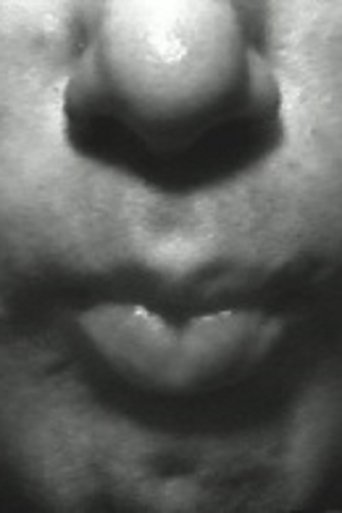
Using extreme close-ups and amplified sound to force the viewer into the space of his body, he experiments with his mouth as a container for saliva, holding it in as long as possible, trying to catch it in his hands.
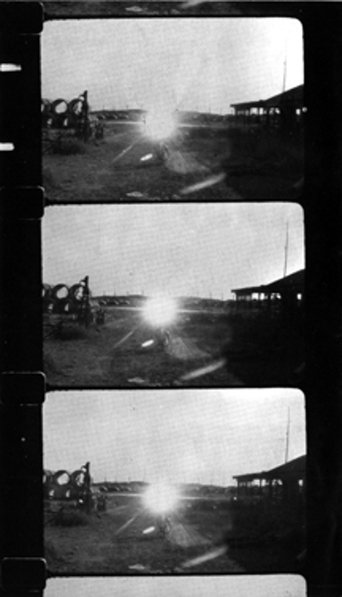
The camera slowly zooms, in over a long period of time, on the light of the sun reflected in the mirror of a bicycle parked at the construction site. To this is added a slowly evolving flicker effect derived from negative-positive reversals, progressively dismantling the distance from the subject. Nakai created a masking film with a calculated pattern of black and white frames into which he inserted positive and negative images and made a print out of two separate rolls of film. The original projection speed was 16 frames per second, but the sound is separate from the open-roll tape rather than burned in, so it can also be screened at 24fps. Also, the original sound consisted of the friction noise of rubbing steel, but in 2019 a new version of the sound was created featuring the friction noise of glass. Two versions of the film exist: 24:15 mins at 24 fps and 40 mins at 16 fps.

Mike Jittlov's 1971 short film Good Grief, made for Dan McLaughlin’s animation class at UCLA and a finalist for shortlisting at the Academy Awards.
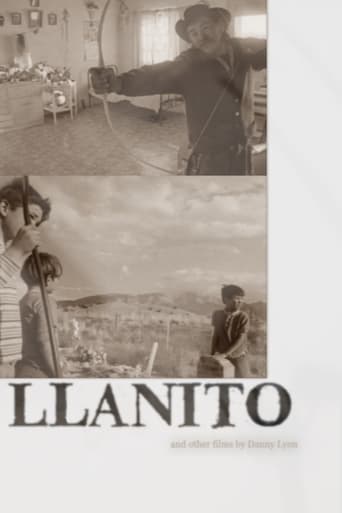
Llanito is the first of Lyon’s trio of films shot in and around Bernalillo, New Mexico, and it is also the screen debut of Willie Jaramillo. The twelve-year-old boy acts as a guiding force for Lyon and his audience, reading out the names on gravestones and relating the stories of the people buried there. He is the focal point of a group of mostly young men with whom Lyon would remain friends and continue to document for the next several decades. The film meanders through the town and among its inhabitants, passing between groups of people at times with the keen instinct of a desert eagle and at others in a drunken stupor, stumbling from one scene into the next with the visceral and irrational inevitability of a gravitational pull.


A chinese documentary.

A teenager's dreams collide with social expectations and gender-based stereotypes when she finds that, despite her parents' assurance that she can be ‘anything she wants to be’, reality presents another story. One of the first and most widely used consciousness-raising films of the growing Women’s Movement, this film helped give voice to a generation of women whose expectations, opportunities and career choices were extremely limited.
Film by Ray L. Birdwhistell produced by the Eastern Pennsylvania Psychiatric Institute
Children will delight in this introduction to primary colours and their combinations--an animated film in which little elf-like creatures make all the discoveries. They emerge from three circles painted red, yellow and blue. When they venture into a circle of another colour they find that they, too, change colour. Their every movement and posture is designed to convince and amuse.
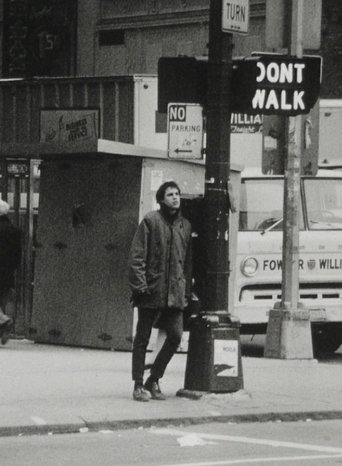
Using fragmented personal imagery, "Next to Me" renders Cartier-Bresson's theory of the "decisive moment" fully in cinematic terms. The film is an expressionistic exercise in editing, which explores the nature of time and memory, film and still photography, against the urban landscape of New York.

A film about woman's onanistic fantasies.

Ten works commissioned by the Scottish Arts Council were broadcast, unannounced, by Scottish TV in August/September 1971. Later, seven were compiled as TV Interruptions (7 TV Pieces).
“Since all matter in the Universe pulsates rhythmically, it is therefore , in constant motion. My film/videos become an activated metaphor to elucidate this phenomenon . I attempt to create psychically charged images that are in a constant state of flux- structured formally but with a poetic intent. Through the use of slow movements and small changes the images become felt, eliciting an almost tactile response."-Director Statement