Several Culprits and One Victim

Several Culprits and One Victim 1970

1

Commissioned by the Ministry of Oil and filmed in the summer of 1970, in Argeș and Ilfov counties, southern Romania, this film was meant to prevent a dangerous practice particularly widespread among people living in rural areas: the transfer of methane gas into homemade containers as a way of stockpiling ‘emergency’ supplies. The film shows a number of accidents of varying levels of gravity, identified after sixteen days of research in the two counties. Via several sync-sound interviews recorded in villages around the region, this stark educational film reveals the vulnerability of a rural world where, as a result of ignorance and lack of education – and also due to limited availability of regulation gas canisters, an issue which remains unmentioned in the film – people ignored basic safety rules on a daily basis and suffered fatal accidents as a consequence.
1970

Report from the Red Flag

Report from the Red Flag 1964

1

Report from the Red Flag is an odd presence against the gloomy background of Stalinist Romania. It belongs to a wider body of Sahia films about the living conditions afforded by the new blocks of flats built across Romania – in this case, a workers’ quarter built in ‘Stalin’-town (the name assigned, between 1950 and 1960, to the Transylvanian town of Brasov). While other films bear the imprint of the collectivist, work-centered ethos of the time, Red Flag follows the workers during their downtime, between Saturday 3pm (the end of the working week) and Sunday evening, while they spend quality time with their families, walking, mountain climbing, biking, fishing, or shopping – an opportunity, today, to see candid images of relaxation shot at a time when the state started paying attention to the leisure and tourism facilities available to its citizens.

1964

Parents' Meeting

Parents' Meeting 1980

1

The Segalls’ interest in children’s lives dated from the mid-1960s, when, using a camera placed off-stage, they filmed the end of the year festivities at their daughter’s nursery. The result was Big Little Feelings, which won the Silver Dove at the Leipzig Festival in 1964. In the years that followed, the idea of including their own child in some of their films did not sit well with the political bureaucrats. In the end, she would only feature briefly in two short sequences at the end of this and another documentary, filmed eleven years later with the same children (The Feelings Have Grown, 1975). In both films, Doru Segall proudly makes clear that he is both the film’s cinematographer and the father of the girl in the image—a personal, autobiographic detail unusual for a Sahia film. Over the following years, the Segalls continued to work on documentaries about children, including Exams (1976), The High Schoolers (1978), Parents Meeting (1980), and The School Leavers (1986).

1980

The Hottest Day

The Hottest Day 1974

1

This film consists of almost twenty minutes coverage of a political rally, filmed by more than ten Sahia cameramen, during the celebration of the thirtieth anniversary of 23 August 1944, ‘the first day of the socialist era’. The Hottest Day is part of a rich author filmography, which includes around one hundred titles, such as A Life Dedicated to the Happiness of the People (1978); Homage (1983); The Party, The Homeland, The People (1986); Heroic Times in Legendary Lands (1987). When the Sahia documentaries obediently followed their political commission, their length could surpass the usual ten to twenty minutes, even reaching feature length. The Hottest Day was one of the shortest film in this category that we could find in the archives.

1974

Film Festival for the Villages

Film Festival for the Villages 1960

1

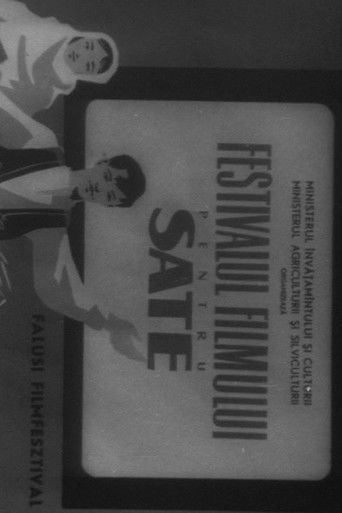
Created with a political-educational purpose and, at the end of the ‘70s, incorporated into the Cîntarea României (Song to Romania) Festival, the Film Festival for the Villages was one of the longest running cultural-political events in Socialist Romania. This film, conceived as a marketing device / trailer for an upcoming festival, is an example of Sahia ephemera. Seen today, it gives us a chance to carry out an ad-hoc archaeology of the film festival as an institution. The film served to increase the festival’s visibility around the country, to announce the dates of the event, and to build expectations among audiences for a certain time of year—in this case, 12 December 1959-31 March 1960.

1960

Lectii de Viață

Lectii de Viață 1970

1

Ohio riddler faces the emperor of Romania in the ultimate clash to see who will be sleeping with Ceaușescu

1970

People Telling Stories

People Telling Stories 1983

1

People Telling Stories is an industrial, health-and-safety commission turned into an aesthetic exercise by one of the most flamboyant young directors at Sahia. In the early 1980s, Romania experienced a crisis triggered by the so-called ‘Transcendental Movement’ (a variation of the ‘Transcendental Meditation’ movement created by Maharishi Yogi, with some significant involvement from the Romanian Secret Police). Those involved, most of them members of the intellectual elite, were harshly repressed. One of them was Paștina, who lost his right to make documentaries for cinema distribution and was demoted to directing health-and-safety films commissioned to Sahia by various institutions.

1983

Along the Frumoasa Valley

Along the Frumoasa Valley 1981

1

The industrial site, the dam under construction and the colony of workers’ housing attached to them are among the favourite spaces of the Sahia documentary, especially during the last decade of the communist regime. The work on the country’s numerous industrial sites is a constant theme included in the annual Thematic Plans of the studio, therefore repeatedly fixed on film and repeatedly missed, or at least simplified by the documentaries of the time, always completed under the pressure of the political imperative.

1981

I Am Also Part of the Three Turns

I Am Also Part of the Three Turns 1970

1

A small town in Buzau province is affected by a destructive flood during the time of an aggressive nationalistic program of urbanization in Communist Romania.

1970

Ajde maestro

Ajde maestro 1970

1

Musical documentary essay on Romanians in the metro in Paris in December 2004.

1970

A Dying Leaf Should Be Able to Carry the Weight of the World

A Dying Leaf Should Be Able to Carry the Weight of the World 2024

1

A Dying Leaf Should Be Able to Carry the Weight of the World is a visit to the botanical garden and museum in Cluj-Napoca, a journey through time and space, a discovery of plants with unknown stories, of plants that don’t exist anymore, of plants that can tell us as much about the past as they can about the future. Fossils, herbs and botanical illustrations are witnesses of the past, proof of evolution and change, but also prophets of what is yet to come.

2024

Sisyphus

Sisyphus 2015

1

"Sisyphus" is a take on insignificance, repetition and the invisible chains that bind us to the routine of our daily lives.

2015

În fiecare zi e noapte

În fiecare zi e noapte 1995

1

A careful portrait of a woman in her fifties. Left without a husband, she has to take on all the household chores in a cramped apartment building, where she lives with her bedridden mother, her immature teenage son who constantly teases her, and his capricious girlfriend – a perpetual agitation filmed with nerve.

1995