I. L'adoration des mages 1898
The first scene in the 1898 Passion Play
The first scene in the 1898 Passion Play

Dotting the horizon on the right of the picture is the great fleet of transports, while scattered all along the beach and piled high to the left are hundreds upon hundreds of ammunition cases.
A review of the Republican Guard and firemen at Longchamp filmed by the Lumière brothers.
The film opens showing the native daughters mounted on horses.
A showcase of trapeze artist Alciede Capitaine, billed as “The Perfect Woman,” whose daring feats on the flying bar combined grace with breathtaking athleticism. Produced by Edison in 1898, this title should not be confused with Dickson’s earlier 1894 short Mlle. Capitaine, which also featured the performer.
A woman slips into her bed with the help of her servant. While the film is lost, there is a new digital version based on re-creation from a flipbook produced by Léon Beaulieu around the same time
With the cameraman atop a moving train car the viewer is given a one minute glimpse of a French urban area.
"On the way to San[ta] Monica, Cal., the train approaches, runs through and emerges from a tunnel. Train passes in opposite direction. Camera is at front end of train, giving a very novel view."
This picture was taken on the line of the Mt. Tamalpais Scene R.R., and whereas the previous views were taken ascending, this is a descending view, the camera being placed on the front end of the train which follows another train consisting of two passengers coaches and an engine.
The pope taking a twilight walk.

Street scene shot from a balloon.
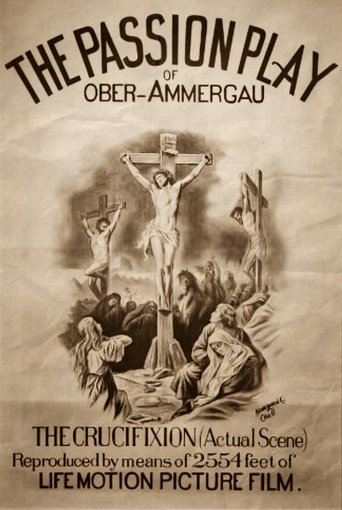
The Passion Play of Oberammergau (1898) presents scenes from the famed Bavarian passion play, dramatizing the final days of Jesus Christ—from his entry into Jerusalem to the Crucifixion and Resurrection. Filmed by the Edison Company, it offered late-19th-century audiences a rare cinematic glimpse of the world-renowned Oberammergau tradition.
A hypnotist tricks his patients. There is no credited director for this film, although three different persons get attributed, Gaston Breteau, Alice Guy or Georges Hatot.
Agents chase down rooftop criminals, and after a series of grotesque twists and turns, they finally get their hands on them.
When Battery B of the 4th U.S. Artillery came to Tampa, Fla., it meant business, and the picture shows it. One by one the big artillery-men pass by in front and reappear in the background, dismounting, unloosing saddle girths and bridles and leading away their mounts. Limbers, gun carriages and caissons in the distance. The sweating horses and the vigorous switching of their tails tell a mute story of hot weather and fly-time. A picture full of reality.
Taken at the Cuban Volunteer Camp at West Tampa, Fla. Men are falling into line, two abreast, every man with his tin cup and dish. Command is given 'forward march' and the column approaches the audience. A fine looking body of men, worthy of a people battling for freedom. Figures are life size and life like. Prominently displayed upon their military hats is the emblem Cuba Libre, a single star in a red tri-colored field. An accurate and interesting subject.
Several men in a basement barbershop become excited by women walking past the window. The ankles and knees of the passersby are visible to the men below, causing pandemonium among the barbershop customers. Possibly released in 1901.
The Switchback Railway was the forerunner of the roller coaster. Passengers sit in a small car which trundles up a swooping railway track then performs a 180 degree turn at its summit before swooping back down on a parallel track.
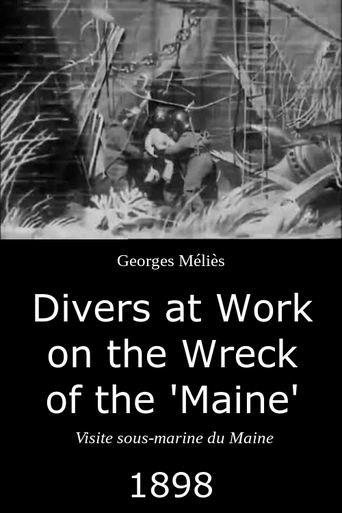
Divers go to work on a wrecked ship (the battleship Maine that was blown up in Havana harbour during the Spanish-American War), surrounded by curiously disproportionate fish.
