
مشهور له Israel
Humit's Zoo 1961
Humit, the kibbutz Dachshund dog, travels to Tel Aviv to see the animals in the zoo. She sees the animals in small cages, unlike the kibbutz monkey, who roams freely and plays with the children, or the pair of porcupines that the children feed with milk from a bowl, and the deer that was adopted and became the friend of the kibbutz’s lamb. There are also turtles, cats, chamalions, and a giant peacock moth in Humit’s kibbutz “zoo,” all of them free to go wherever they like, except for the golden hamster. Bedouins arrived with their herds in the area next to the kibbutz, and the kibbutz children went to watch a camel calf being born.
The United Kibbutz Newsreel #7 - The Kibbutz Brigade in Eilat 1956
Between the mountains of Edom and the Red Sea, the younger and older workers of the United Kibbutz Brigade positioned themselves in order to build and settle the city of Eilat. Under the leadership of Beni Marshak, the organization’s secretaries are exploring the possibility of establishing permanent structures while supervising British activities in the area. Meanwhile, in the brigade camp, meals are being prepared and clothes are being thoroughly washed by the dedicated female brigade members. The brigade members take on tasks for the preparation of the settlement, in carpentry, fishing, planting gardens and orchards, and in the construction work of a Solel Boneh. The 12th grade students from the Kibbutzim come to be impressed by the pioneering work in the city.
The United Kibbutz Newsreel #5 - Gesher HaZiv Camp 1955
After the hero of this story saw hundreds of boys and girls participating in the first national camp of the Youth Companies Brigade that took place in Gardosh (Kibbutz Parod), he decided to join the movement. Taking part in the third camp, he, together with his fellow brigade members, set up the camp tents on the beach next to Kibbutz Gesher Haziv, and after a march, they prepared a big meal. The camp held sports activities and martial arts, games, and an art exhibition.
The United Kibbutz Newsreel #3 1955
Modern machines and marble sculptures – documentation of the works in the port of Caesarea alongside the antiquities of Caesarea. Rehearsals of the orchestra of the United Kibbutz and the National Kibbutz, towards a concert for kibbutz workers. With locally made playgrounds, the kibbutzniks celebrate the 24th anniversary of Kibbutz Naan. About 3,000 people came to dine and participate in the 17th conference of the United Kibbutz in Givat Brenner, which opened with a musical performance, created by Benjamin Pintos. Besides discussions about the future of the kibbutz, in which Yitzhak Tabenkin, Zeev Tzur, and Israel Bar Yehuda participated, an exhibition of the United Kibbutz’s artists was being held. Hakibbutz Hameuchad – Sifriat Poalim Publishing Group Bookstore opened in Tel Aviv.
The United Kibbutz Newsreel #2 1955
The inauguration ceremony of the monument to the victims of the Harel Brigade of the Palmach during the War of Independence in the cemetery in Kiryat Anavim. A glimpse into the work of the fishermen of Kibbutz Nachsholim on their ship Nachshol, sailing towards the fishing grounds off the coast of Turkey. A veterinarian performs surgery and removes nails and glass from a cow’s stomach. And finally, a request not to throw away cigarette waste where it could cause a fire.
The United Kibbutz Newsreel #1 1954
The kibbutz artists and sculptors gathered in Naan and presented some of their works at an exhibition on the kibbutz lawn and in the exhibition halls. Representatives of the United Kibbutz presented their innovations at the agricultural machinery exhibition held in Haifa Bay. Every week, 10,000 copies of the “Bakibbutz” newspaper are edited, printed, and distributed among the kibbutzim.
Hakibbutz Hameuchad (United Kibbutz) Film and Reel Collection 1955-1970 1970
The collection comprises a series of films and newsreels shot and edited over a 15-year period, between 1955-1970, at the ‘Kibbutz Hameuchad’ film studios that were based in Kibbutz Na’an, just under the open-air theatre stage. The films and reels were shot both in black and white and technicolour, and were predominantly focused on capturing kibbutz life, and the growth and development of Jewish communities in the land, including agricultural work, culture and art events, holidays and festivities, trips and youth camps, United Kibbutz conferences and council meetings, the kibbutz’s children society, and lots more.
Together 1973
An animated corporate video produced by Histadrut. In order to protect its members’ standard of living, Histadrut operates many different initiatives: trade unions, which protect workers’ rights, the Strike Fund (which pays wages of striking workers), nursing homes’ chain Mishan, construction of apartments for the poor, cultural and educational activities for adults, care for working youth, sports club Hapoel, banking services provided by Bank Hapoalim, a chain of affordable department stores, and most of all funding of medical services for members of Kupat Holim Clalit.
Kibbutz Moshav Moshava - Moshav 1973
The three anonymous protagonists of the film are each sent to a different type of community a kibbutz, moshav, and moshava, to learn about their special characteristics and the different lifestyles of their residents, and also meet a mysterious girl along the way. In this part, we follow our hero (Hanan Yovel) who was sent to a moshav.
Kibbutz Moshav Moshava - Kibbutz 1973
The three anonymous protagonists of the film are each sent to a different type of community a kibbutz, moshav, and moshava, to learn about their special characteristics and the different lifestyles of their residents, and also meet a mysterious girl along the way. In this part, we follow our hero who was sent to a kibbutz.
Kibbutz Moshav Moshava - Moshava 1973
The three anonymous protagonists of the film are each sent to a different type of community a kibbutz, moshav, and moshava, to learn about their special characteristics and the different lifestyles of their residents, and also meet a mysterious girl along the way. In this part, we follow our hero who was sent to a moshava.
Our Lamb 1960
The kindergarten children receive a gift from the kibbutzs shepherd a small lamb. A little girl named Michal feels a special connection to the lamb. During a special celebration, the lamb is given the name Pamonit and as a gift, it receives a red ribbon with a bell around its neck. One bright morning, the lamb disappears. Special search groups are organized, but without results. Time passes, but Michal cannot overcome her longing, and she continues her search in hopes of finding him.
The Hunter 1978
A young soldier catches a cockroach during a moment of boredom at his base. In doing so, memories from his childhood surface, of a time when he discovered the world through curious eyes and used to catch pigeons and release them along the seashore.
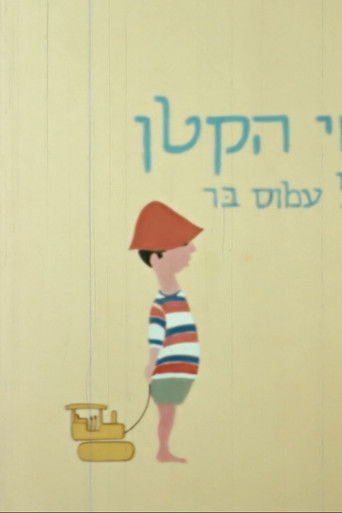
The Little Tractors Man 1964
A short children’s film based on the first children’s book by the author Amos Bar. Hillel loves tractors more than any other child on the kibbutz. A friend on the farm who understands the boy’s spirit gives him a ride on the tractor almost every morning on his way out to the fields. One day, during a trip with his friends, Hillel discovers that the tractor broke down in the middle of the field. He decides to separate from the group of children and sneak up to the tractor, which is standing alone, while the tractor driver goes to fix the oil pump. He sits on the tractor and plays with the levers. Soon enough, panic ensues as his friends, from a distance, hear the noise of the tractor in the field, which is moving on its own. After a dramatic chase, the tractor stops, and Hillel is saved. Hillel, who leaves the impression that he will be a successful farmer when he grows up, is forced to promise for now that he will not get on a tractor for the next 7 years.

In The Land Of The Negev 1975
An Israeli Film Service documentary, describing the two faces of the Negev: unspoiled desert landscape alongside modern Israeli settlements. The film documents the culture and commerce in Beersheba, the works in Timna Valley’s copper mines and the Aravah’s agricultural fields, and the technological strongholds of Ben Gurion University’s labs, the Wise Observatory, and Eilat’s desalination plant. Alongside the modernization, the film captures the surrounding desert nature and wildlife, the Nabataean archaeological sites in the Negev, as well as the remains of the War of Independence in Mizpe Revivim.
People in the Valley 1973 1973
A documentary produced by the Center for Culture and Education and the Agricultural Center of the General Federation of Workers in the Land of Israel. On the arid, water-scarce hills of the Jordan Valley, more and more Jewish settlements are being established and built, such as Petzael, Naaran, Argaman, and Gilgal. These settlements, despite the lack of water and the intense heat, are becoming agricultural communities that attract young people and families. Residents of Gilgal describe life in the settlement, working in the intense heat during the day in the fields or in the sprinkler factory, and watching movies together in the evening. The film ends with a report on the outbreak of the Yom Kippur War.

Fairuz 2024
Fairuz, a seventh-grade student from the Hatikva neighborhood, attends a school for children of immigrant and asylum-seeking parents. When Fairuz experiences a crisis in her studies, her teacher, Dodi, does not let her give up until she achieves success. The film won second prize for documentary in the Wim Van Leer Competition for High School Students. The prize is sponsored by the David Herman Film Award.

Not for Broadcast 1981
Director Yeud Levanon’s feature-length debut follows the story of Itzik (Gedalia Besser), a military radio station producer who, in between having to navigate all the internal power struggles at the station, must also juggle his estranged wife (Gila Almagor), teenage daughter, young pregnant partner (Dafna Armoni), and a soldier with whom he is having an affair (Irit Sheleg). Meanwhile, he is also working on getting a young Middle Eastern folk singer’s (Arnon Zadok) album produced. The film’s protagonist is living a mile-a-minute life made up of constant downward spirals or ego-tripping highs. However, try as he might to have his cake and eat it – it is only a matter of time until his whole world comes crashing down on him.
Mother's Visit 1969
A mother comes to visit her son at his pre-military academy in kibbutz Sha’ar HaGolan. They spend a day together, just like old times when he was a boy.

