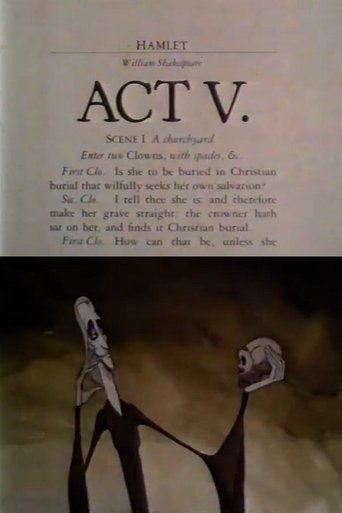
Act V. 1981
Shakespear's Hamlet Act V. animated. Hamlet suspects his uncle has murdered his father to claim the throne of Denmark and the hand of Hamlet's mother, but the prince cannot decide whether or not he should take vengeance.
Shakespear's Hamlet Act V. animated. Hamlet suspects his uncle has murdered his father to claim the throne of Denmark and the hand of Hamlet's mother, but the prince cannot decide whether or not he should take vengeance.

Fragmented images of the female body, recalling sensuous landscapes, suggest the objectification of women in a culture that renders them silent.
Traces independent filmmaking in 1930s Britain, focused on coverage of political marches and rallies. Essay film, formed from the archives of the Film & Photo League with the Kino Group.
A video short by Andrew Huestis featuring Dale Hoyt
Video short by Andrew Huestis
Leon Brown, a young psychologist, find pamphlets, handbills and other critical materials concerning Marcus Garvey and his period in a trash can in Philadelphia. Intensely motivated, he follows the leads to the still active Universal Negro Improvement Association.
Flesh, Metal, Wood is an experimental film combining visual and musical elements to create a unique exploration into the spiritual nature of creative music. It examines the foundations of the musical form referred to as avant-garde jazz through the mental experiences, dreams, and visions of a young musician.
Marian Wallace solves a Rubik's Cube.

Some of the films are presented in tandem in darkened interiors that resemble the caves where Mendieta sculpted some of her final works. One film depicts the artist lying naked in a creek, suggesting cleansing and rebirth. In another film, "Keane College Volcano" at Galerie Lelong, the wind is gently stirring a mound of ash that swirls up from a stone form's breast. The bluish powder twirls up and teasingly dissipates. This breathless little dance,this choreographed chance of the elements is the best. Ana Mendieta may have written her name on the earth in disappearing ink, but she did it so well that we can't erase it.

Resisting the binary essentialism of contemporary second-wave feminism, Bean's work points to a more complex celebration of being. Here, she draws on the ecstatic yet troubling inter relationship of a small beetle and its ant hosts, where the beetles secrete a substance that is greedily licked up by the ants to suppress their usual aggression, meaning they can be torn apart by the beetle whilst still submitting themselves to it.

Dibakar, a humble factory worker sets out with his wife for his marital home in Choto Bokulpur as his wife was disturbed after hearing the news of unrest and violence there. She wants to assure that her parents are safe amidst the revolution of the peasants which the police and army were trying hard to suppress. As they reach the outskirts of the village they are stopped by few men who start questioning them. They are thoroughly searched and their luggage is thrown open to check if they are revolutionaries. They get no evidence against them in their luggage. But, when Dibakar is searched they find a paan wrapped in a piece of paper bearing an advertisement lauding the brave efforts of the revolutionaries and condemning the tortures of the suppressors. Despite Dibakar’s repeated assurance that he isn’t a revolutionary they kill him mercilessly and thus ends an innocent life.
16mm experimental short film.
A project by Tomasz Sikorski
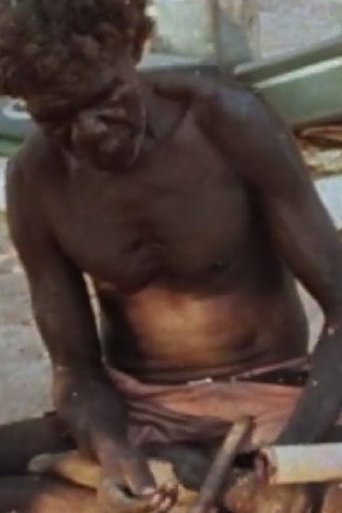
In 1974, Narritjin Maymuru and his family are establishing a small settlement at Djarrakpi, an important Manggalili clan site on the northern head of Blue Mud Bay in the Northern Territory.
Short educational film by Vladimir Kobrin.

On the Indonesian island of Bali, the arts permeate almost every aspect of daily life. Gamelan music, wayang (shadow puppet) theater, dance, and elaborately constructed offerings of foods and flowers all represent attempts to please the gods and placate demons. In Balinese cosmology, demons are thought to dwell in the watery underworld, gods in the upper world, and human beings in the middle realm between the two. Much of human effort is directed toward maintaining the proper balance between these worlds, and between the forces of growth and decay.

The series is a picture of the formation of the Zakopane community and the entire Podhale region, seen through the prism of historical and socio-economic changes over the years 1825-1918. The plot of the episodes shows: events of social and historical importance on the symbolic example of a highlander family - the Gąsienica family; and "human" matters - the great ones, such as love, death, murder, and the ordinary, everyday ones, such as work, struggle for existence, entertainment and fun.
In a humourous and bittersweet fashion, New Freedom takes a critical look at how television and the news media in general continue to project a stereotypical image of women in relationships.
