
A View Taken from a Mobile Platform, I 1900
First of a series of films showing visitors to the Paris Exposition 1900 standing on a mobile wooden platform.
First of a series of films showing visitors to the Paris Exposition 1900 standing on a mobile wooden platform.

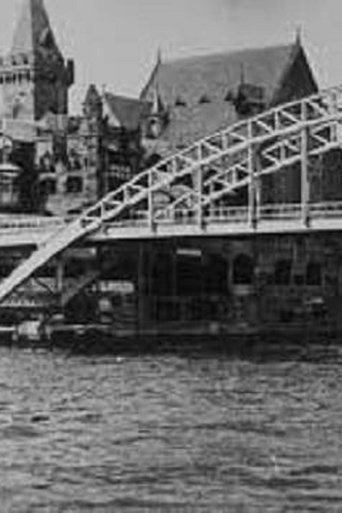
Paris seen from a boat, in this Lumière short film.
A white actor in blackface steals a chicken and hides in a coal bin. A policeman looks in the coal bin, sits on the lid and calls for help. The man happily escapes after he pushes the policeman off the lid.
Throngs of men in top hats walk past the camera.
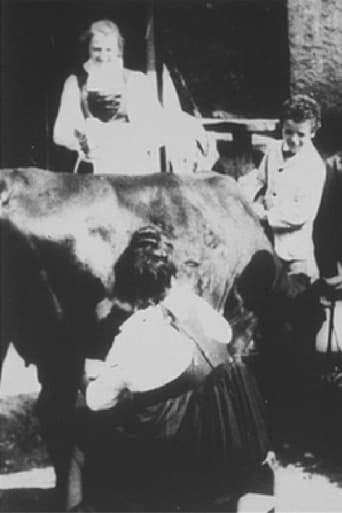
A man flirts with a milk maid.
A chimney sweep and a miller become involved in a street fight. The sweep has a bag of soot on his back, and the miller a bag of flour.
AN UNEXPECTED BATH" shows the astronomer watching women rain down from the heavens.
This picture shows thousands of people leaving their seats in the grand stand and going across the parade grounds toward Paris. A very sharp and clear picture.
Funeral ceremonies in memory of King Umberto I, attended by President Campos Sales.
Villa Negro is a silent travelogue of unknown date and production company, preserved in a 35mm print (300 ft., 4'53" at 16 fps) with German intertitles, held by the BFI National Archive in London. According to notes by Renato Venturelli in the 44th Pordenone Silent Film Festival catalogue, the film opens with a view labeled “Villa Negro,” referring to Villetta Di Negro—a public park in Genoa that was formerly a cultural center in the early 19th century. The villa is shown from Piazza Corvetto, with statues of Giuseppe Mazzini and Victor Emmanuel II. The film also includes views of Castello Mackenzie, designed by Gino Coppedè, as well as scenes of a coastal storm, the Cathedral of San Lorenzo, the Church of the Nunziata’s vestibule, the Columbus monument in Piazza Acquaverde, Palazzo Doria (Villa del Principe), and the Staglieno Cemetery. The surviving footage is fragmentary but features consistent image quality and frequent panoramic camera movement.
Actuality film recording the entry of British Commander-in-Chief Lord Roberts into Pretoria during the Second Boer War. The scenes show the victorious march and ceremonial arrival of Roberts and his troops, commemorating a key moment in the British campaign.
Shot in 1900, the film is of Elizabeth Yates, a trailblazing woman elected Mayor of Onehunga in 1893 – just a few weeks after New Zealand women became the first in the world to win suffrage and the right to vote in a general election. Created by Enos Pegler for the Zealandia Living Picture Company, the film is a re-enactment – most likely of a speech Yates gave to the local council. Lacking sufficient lighting technology, many early films were filmed outdoors on a set made to look like it’s inside. This film is no exception – look closely and you will see the ‘walls’ are blowing in the breeze.
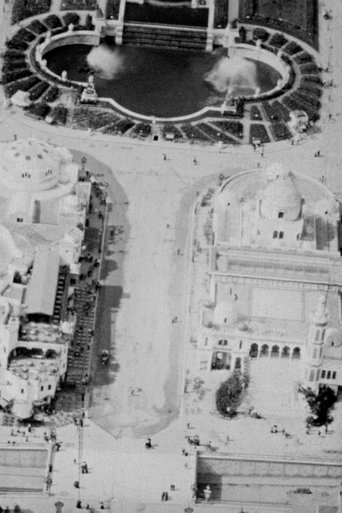
A panoramic bird's-eye view of Paris and the Exposition. Taken from a captive balloon, the camera being pointed downward so that the exact effect is obtained that one would have in looking over the side car of a balloon. The figures of the people below are mere dots, and the buildings are seen in complete groups.

The parade of carriages, costumed riders, and exotic animals passing over the bridge at Inverness, Scotland, has attracted a crowd, despite the rain.
Several painters unsuccessfully try to paint something on a canvas. A man enters the scene and with a single brushstroke achieves a huge sign that says: Oliver, Juncal 108.
